

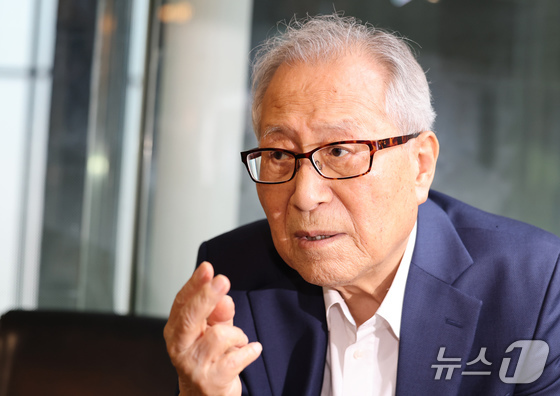
Former Unification Minister Jeong Se-hyun stated on Tuesday that achieving denuclearization on the Korean Peninsula requires the U.S. to promise or guarantee it won’t use nuclear weapons against North Korea.
Jeong made these remarks during his address at the 2026 NK Forum held at the Westin Chosun Hotel’s Orchid Room in Seoul, an event organized by the National Security Strategy Institute.
He began by referencing President Lee Jae Myung’s recent March 1 Independence Movement Day speech, which called for transitioning from an armistice to a peace system. Jeong emphasized that resolving the peninsula’s denuclearization issue is crucial in this process.
Jeong clarified a common misconception, stating that many assume Korean Peninsula denuclearization simply means ‘North Korean denuclearization, but that’s not accurate. He stressed that since the North Korean nuclear issue emerged in 1993, the concept has included removing U.S. nuclear weapons from the region.
He added that if it asks the U.S., which is hesitant to return wartime operational control, to promise not to use its nuclear capabilities against North Korea in East Asia, they might respond, We’re not considering such denuclearization, or, We’re not interested in a U.S.-North Korea summit under those terms.
Jeong predicted that future U.S.-North Korea talks could involve intense debates, not just about denuclearization demands or recognizing North Korea’s nuclear status, but about precisely defining denuclearization.
The forum, themed Exploring Viable Paths for Denuclearization and Peace on the Korean Peninsula, aimed to analyze the North Korean nuclear issue’s structural implications amid shifting global dynamics and seek practical solutions. Notably, 30 diplomats from 19 countries attended the event.
Kim Sung-bae, director of the strategy institute, emphasized that the North Korean nuclear issue isn’t just a problem to solve, but a structural challenge requiring both management and adaptation in the evolving international political landscape. He advocated for a balanced approach between principles and reality, coupled with a phased strategy through international cooperation.