

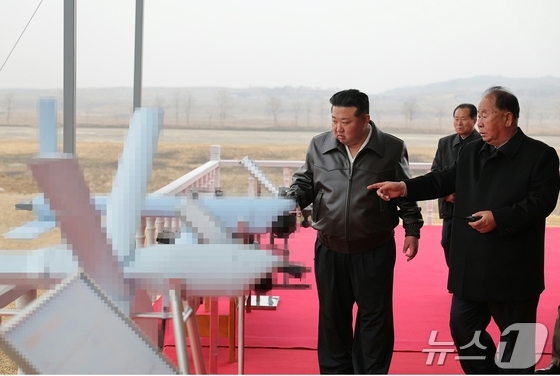
As the use of kamikaze drones expands in modern conflicts, such as the Russia-Ukraine war and U.S.-Iran tensions, experts are calling for enhanced protective designs at military installations.
A March 22 report by Korea Institute for Defense Analysis (KIDA) researchers Kwak Han-sung and Kang Min-gu highlights the battlefield impact of drones like the U.S. Switchblade series, China’s DFX-100, and Russia’s Geran-2. These unmanned aerial vehicles (UAVs) can deliver payloads of up to 50 kg (about 110 pounds), demonstrating their lethal potential.
Drones capable of carrying 30 kg-plus (about 66-pound-plus) bombs or missiles pose a severe threat. They can inflict critical damage in a single strike and execute kinetic impact attacks, dramatically escalating the risk level.
The study focused on suicide drones targeting key facilities directly. North Korea’s drone program appears to prioritize kamikaze UAVs over traditional bomb-droppers, while gunfire attacks were excluded due to their limited effectiveness against standard reinforced concrete.
Intelligence estimates suggest North Korea possesses roughly 1,000 drones for various missions, from reconnaissance to offensive operations. The Banghyeon I and II, VR-3, and MQM-107 are believed to be adaptable for suicide missions.
Developed indigenously in the early 1990s, the Banghyeon I and II can reportedly carry 20-25 kg (about 44-55 pound) payloads. The VR-3, a modified Russian design, and the MQM-107, an American target drone acquired via Syria, boast even greater payload capacities of 200 kg (about 440 pounds) and 401 kg (about 882 pounds), respectively.
While South Korea is actively developing multi-layered counter-drone systems, the report criticizes current defenses as inadequate against high-speed, autonomous, and swarming suicide drones.
The researchers noted that radar struggles with drones’ low radar cross-sections and nap-of-the-earth flight profiles. Jamming is less effective against military-grade encrypted communications. Directed energy and the electromagnetic pulse (EMP) countermeasures are limited to single, close-range targets.
Current Defenses Focus on Conventional Threats; Drone-Specific Adaptations Needed
The possibility of drone swarms penetrating defenses to strike critical assets can’t be discounted. The report emphasizes incorporating blast-resistant and protective designs that anticipate drone breaches.
Existing blast protection standards, based on conventional weapons like rocket artillery and guided bombs, may be insufficient. While North Korean drone payloads fall within considered weight ranges, the analysis doesn’t account for multiple, successive detonations characteristic of drone swarms.
Modern drone warfare differs from traditional attacks. Kamikaze drones’ effectiveness varies with detonation distance, necessitating revised blast design parameters for wall thickness and stand-off distances.
The report warns that standard military facilities using reinforced concrete (RC) structures are highly vulnerable to current drone threats. Typical RC wall thicknesses of 20-30 cm (about 8-12 inches) fall short of the 40.93 cm (about 16 inches) needed to defeat even the smallest North Korean suicide drones.
Detonation distance is crucial in revising protective designs. Research indicates that at ranges beyond 2.5 m (about 8.2 feet), standard RC structures could withstand smaller drones like the Switchblade or Banghyeon I/II carrying sub-10 kg (about 22-pound) payloads.
Larger drones like the DFX-100 or Geran-2 would likely cause minor to moderate damage, while the VR-3 could inflict severe structural harm. The MQM-107 poses a total destruction risk. However, increasing stand-off to 5 m (about 16.4 feet) reduces even MQM-107 damage to severe rather than catastrophic.
The report concludes that recent conflicts show drones targeting not just facilities, but also weapon systems like tanks and strategic bombers. Risk assessments for both kamikaze impacts and bomb drops must inform future blast protection and defensive designs.