

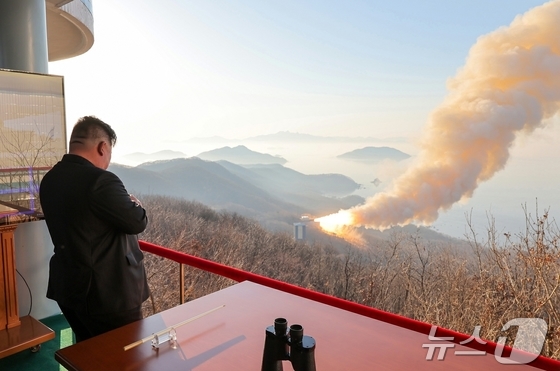
North Korea has unveiled a groundbreaking test of a new solid-fuel engine, achieving record-breaking thrust. Kim Jong Un, the Supreme Leader of North Korea, has consistently emphasized the nation’s nuclear power status, raising concerns about potential future tests of multiple independently targetable reentry vehicle (MIRV) intercontinental ballistic missiles (ICBMs) capable of striking the U.S. mainland.
According to the March 29 edition of the Rodong Sinmun, the official newspaper of the Workers’ Party, Kim observed a test of a high-output solid-fuel engine constructed with carbon fiber composites. The exact date of the test was not disclosed. These engine tests are conducted to verify thrust and identify any technical issues during ignition and propulsion phases.
The Rodong Sinmun claims the new solid-fuel engine boasts a maximum thrust of 2,500 kilonewtons (kN). If accurate, this represents a more than 20% increase over the 1,971 kN thrust of the solid-fuel engine North Korea reportedly equipped on its new Hwasong-20 ICBM last September.
North Korea previously reported a 40% thrust increase in its engine development, indicating rapid advancements in solid-fuel propulsion technology. Speculation suggests possible Russian technical assistance in this process.
While unverified, the claimed 2,500 kN thrust significantly surpasses that of major powers’ ICBMs. For comparison, the U.S. Minuteman III ICBM generates approximately 891 kN of thrust, while Russia’s Topol-M ICBM produces about 913 kN. China’s DF-41 ICBM is estimated to have 1,100-1,400 kN of thrust. The 2,500 kN figure even exceeds the 2,180 kN of the retired U.S. Peacekeeper LGM-118A.
North Korea has been steadily improving its solid-fuel engine technology, moving away from liquid-fuel engines that require time-consuming fueling processes and are more vulnerable to detection by U.S. and South Korean intelligence. Solid-fuel engines, which can be pre-loaded onto mobile launchers, offer significant tactical advantages. As engine power increases, so does the potential payload capacity, range, and number of warheads an ICBM can carry.
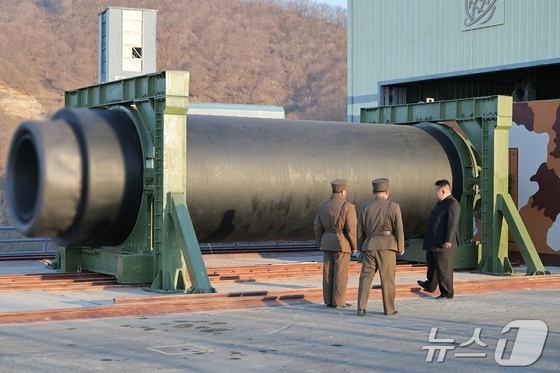
Intelligence estimates suggest North Korea already possesses ICBMs capable of reaching the U.S. mainland (approximately 15,000 km, about 9,320 miles). Building on this foundation, Pyongyang appears focused on developing MIRV ICBMs with enhanced engine output. MIRV technology allows a single missile to deliver multiple warheads to different Targets, potentially overwhelming missile defense systems and enabling simultaneous strikes on key facilities.
By showcasing its advanced nuclear capabilities, North Korea likely aims to bolster its negotiating position with the United States and demonstrate its strengthened deterrent. Some analysts speculate that North Korea may be attempting to differentiate itself from Iran in light of ongoing Middle East tensions, emphasizing its ability to launch an immediate nuclear counterattack in response to any U.S. aggression.
North Korea continues to demonstrate its commitment to enhancing both defensive and retaliatory capabilities. Recent examples include the April 4 and 10 tests of strategic cruise missiles launched from its new 5,000-ton destroyer, the Choe Hyon-ho.
Hong Min, a senior researcher at the Korea Institute for National Unification, stated that this latest engine test confirms North Korea’s determination to field ICBMs with global strike capabilities and the ability to penetrate missile defense systems through MIRV technology. It aligns with their new five-year defense plan’s goal of continuously upgrading strategic strike assets.
While some experts anticipate a potential MIRV ICBM test in the near future, others caution that such advanced systems require the integration of multiple cutting-edge technologies beyond just propulsion.
Yoo Ji-hoon, a researcher at the Korea Institute for Defense Analyses (KIDA), explained that MIRV ICBMs demand not only powerful engines but also miniaturized nuclear warheads, advanced reentry vehicles, precise warhead separation mechanisms, and highly accurate guidance systems. While North Korea is clearly progressing beyond basic ICBM upgrades towards more sophisticated strategic weapons, it can’t yet confirm their operational readiness for such complex systems.
Yoo added that the U.S. and South Korea must view these developments as part of North Korea’s long-term military modernization strategy, encompassing advancements in propulsion, materials science, and production techniques. As North Korea integrates solid-fuel propellants with mobile launch platforms, the challenge of mounting preemptive responses increases significantly. This necessitates enhanced Intelligence, Surveillance, and Reconnaissance (ISR) capabilities, improved mobile target tracking, and faster, more robust information sharing and command and control systems between U.S. and South Korean forces.