

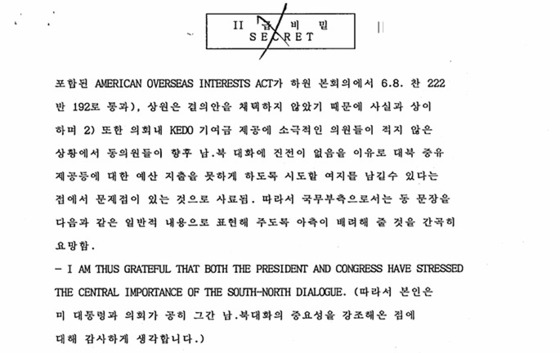
In July 1995, prior to then-President Kim Young-sam’s visit to the U.S., the U.S. State Department requested direct modifications to North Korea policy related phrases in the draft of the South Korean president’s congressional address. This move reflects the U.S. government’s meticulous management of the political landscape, aiming to prevent budget-critical opposition members in Congress from finding pretexts for cutting North Korea aid funds.
On Tuesday, the Ministry of Foreign Affairs released key contents from 2,621 diplomatic documents (about 370,000 pages) that were declassified after 30 years.
Senate Still Pending… State Department Tweaks Speech to Safeguard KEDO Budget
The released documents included materials detailing preparations for President Kim’s July 22-28 U.S. visit the following year, aimed at bolstering U.S.-South Korea relations after the U.S. initiated direct talks with North Korea post-1994 Agreed Framework.
On July 25, 1994, a day before President Kim’s joint congressional address, the State Department urgently requested revisions to parts of the speech. The contentious phrase expressed gratitude for Congress adopting a resolution emphasizing inter-Korean dialogue’s importance in implementing the Agreed Framework.
The State Department noted the Senate hadn’t yet adopted the resolution and conveyed concerns about the internal political climate. They worried that opposition members, particularly Republicans critical of North Korea aid budgets like heavy fuel oil provision for the light-water reactor project, might exploit the phrase.
If the South Korean president expressed gratitude assuming progress in inter-Korean dialogue, and relations later deteriorated, opposition members could argue that promises weren’t kept, potentially justifying North Korea aid budget cuts.
Consequently, reflecting the U.S. request, the phrase was revised to a more cautious and inclusive statement: It appreciates that both the president and Congress have consistently emphasized the importance of inter-Korean dialogue.
Amid Bypassing South Korea Concerns… President Kim Stresses No U.S.-North Korea Improvement Without Inter-Korean Dialogue
After the 1994 Agreed Framework, as the U.S. engaged directly with North Korea, concerns grew in South Korea about being sidelined in negotiations.
The Agreed Framework, reached in Geneva, Switzerland, came after North Korea’s 1993 announcement of withdrawal from the Nuclear Non-Proliferation Treaty (NPT). Under this agreement, North Korea agreed to halt its nuclear program in exchange for U.S. energy assistance, including light-water reactors, heavy fuel oil, and nuclear power plant construction.
Throughout his U.S. visit, President Kim repeatedly emphasized that U.S.-North Korea relations couldn’t improve without inter-Korean dialogue.
During the White House official dinner and lunch with Vice President Al Gore, President Kim underscored that supporting South Korean-style light-water reactors transcended nuclear issue resolution, impacting the entire Korean Peninsula. He firmly stated that no compromise on principles was possible.
He also pledged to honor commitments related to North Korean light-water reactor aid, provided South Korean-style reactors were adopted and Korea’s central role assured. However, he urged increased U.S. efforts, noting no signs of inter-Korean relations progress on the reactor issue.
The Ministry of Foreign Affairs established diplomatic document disclosure regulations in 1993 and began releases in 1994. By last year, it had disclosed about 40,000 documents (5.7 million pages) produced between 1948 and 1994 over 32 occasions. The original texts of newly released diplomatic documents are available for review in the ‘Diplomatic Documents Reading Room’ at the Diplomatic Archives.