

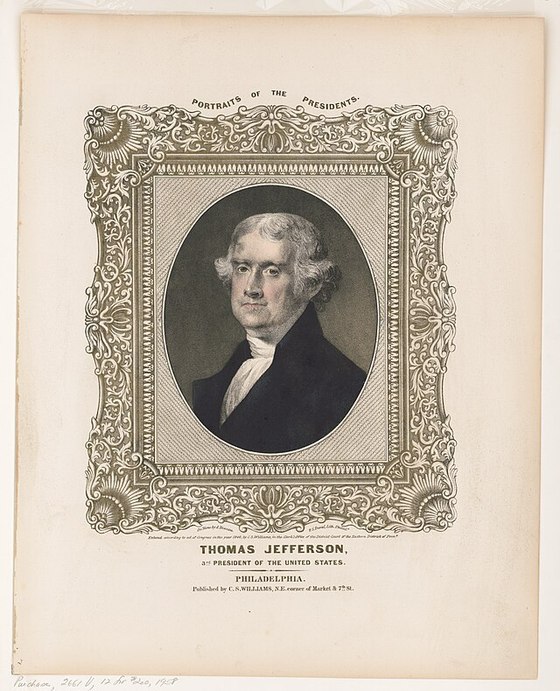
Thomas Jefferson, a principal architect of American independence and the third president of the United States, was born April 13, 1743, in Shadwell, Virginia, United States.
Jefferson is widely regarded as a statesman, philosopher, architect and scientist who played a central role in shaping the foundations of American democracy.
His most notable achievement came in 1776, when he drafted the United States Declaration of Independence, articulating the principle that “all men are created equal.” He also championed what became known as Jeffersonian democracy, opposing centralized authority while emphasizing local governance and individual liberty. In 1786, he authored the Virginia Statute for Religious Freedom, which established the principle of separation of church and state and advanced civil liberties.
Jefferson assumed office as the third president of the United States in 1801, demonstrating pragmatic diplomacy and decisive leadership. In 1803, he completed the Louisiana Purchase, acquiring vast territory from France for $15 million, effectively doubling the size of the nation. He later commissioned the Lewis and Clark Expedition to explore the newly acquired western lands.
After leaving office, Jefferson founded the University of Virginia in 1819, promoting higher education and scholarship. His extensive personal book collection later formed the foundation of the Library of Congress. His estate, Monticello, stands as a testament to his architectural vision.
Jefferson’s legacy also reflects contradictions. While advocating equality, he was a slaveholder, a fact often cited as a defining paradox of his life. Nevertheless, the democratic ideals and intellectual contributions he advanced remain central to the identity of the United States.
Jefferson died on July 4, 1826, the 50th anniversary of the nation’s independence. His epitaph notably omits his presidency, instead highlighting his authorship of the Declaration of Independence, the Virginia Statute for Religious Freedom, and the founding of the University of Virginia.