

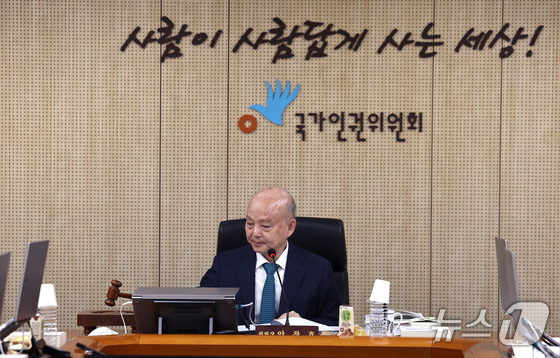
The National Human Rights Commission (NHRC) has decided to issue a statement urging the Minister of Foreign Affairs and the Prime Minister to pursue all diplomatic efforts for the repatriation of North Korean prisoners of war detained in Ukraine.
On Monday, during its 7th plenary session in Seoul, the NHRC unanimously passed a resolution titled, Recommendation for the Protection of Life, Physical Integrity, and Mental Health of North Korean Prisoners of War in Ukraine and Humanitarian Measures for Their Entry into South Korea.
The NHRC expressed its intention to ensure that North Korean prisoners are not forcibly repatriated against their will and to respect their freedom of choice, facilitating safe entry into South Korea or other countries through all necessary diplomatic channels.
Furthermore, the NHRC included in its statement a commitment to continuously support the Ukrainian government in safeguarding the well-being of the North Korean prisoners. It also aims to collaborate closely with relevant international organizations to create an environment where the prisoners’ human dignity is preserved.
Previously, NHRC commissioners Lee Han-byeol, Han Seok-hoon, and Kang Jeong-hye jointly proposed discussing the swift repatriation of North Korean prisoners. However, some commissioners raised concerns about verifying the prisoners’ desire to come to South Korea and insisted on confirming the government’s negotiation process.
During the plenary session, Kim Young-mi, a producer specializing in international conflicts, testified that the North Korean prisoners indeed wished to come to South Korea. Kim had interviewed the prisoners in Ukraine last October, and the content aired twice on MBC’s investigative program this year.
Kim stated that the two prisoners are certain about their desire to go to South Korea. They said that if they were sent back to North Korea, they would surely face execution.
Kim explained that the prisoners preferred South Korea over other countries because they were unfamiliar with many nations and believed that countries like Russia and China were under North Korean influence. For their safety, they felt that South Korea was the best option.
Kim also noted that this is the first instance of North Korean soldiers being captured in another country since the Korean War. It believes the South Korean government has been slow to act due to the lack of precedent. She emphasized that the NHRC’s recommendations carry more weight than any judicial decision and have the power to prompt action from government agencies.
However, some commissioners argued for another plenary session to reconfirm the Foreign Ministry’s efforts regarding repatriation. The Foreign Ministry reportedly stated in an official document on March 11 that it would accept the North Korean prisoners if they wished to come to South Korea and firmly opposes any forced repatriation to Russia or North Korea against their will.
Commissioner Lee Sook-jin suggested that if it’s going to make a recommendation, it should give the Foreign Ministry an opportunity to testify, even if they are not the direct victims of human rights violations. She added that typically, when the commission makes recommendations to relevant agencies, they demand improvements in policies and practices or express opinions, necessitating the presence of the parties involved.
Commissioner So Ra-mi also emphasized the importance of formally inviting the Foreign Ministry to participate in the plenary session and provide testimony. She stressed the need to verify how the NHRC and the Foreign Ministry communicated beforehand to ensure that the agency in question is more receptive to the NHRC’s decisions.
In contrast, commissioners Lee Han-byeol and Han Seok-hoon argued that even if they postpone the decision to require the Foreign Ministry’s attendance, it is unlikely that the Ministry will show up.
Commissioner Han pointed out that while the Foreign Ministry has confirmed medical support for the prisoners and the principle of prohibiting forced repatriation, they have not provided any active responses regarding their inaction on the legal obligation to repatriate them to South Korea. They are delaying the repatriation due to their relationship with North Korea, and even if it extends the deadline, the situation will not change.
He continued that if the commissioners are hesitant to make a recommendation and are reluctant to express their opinions, it hopes it can at least issue a statement today.
Ultimately, the NHRC agreed to issue a statement rather than a recommendation. They decided to exclude the Minister of National Defense and the Director of the National Intelligence Service from the statement, including only the Minister of Foreign Affairs and the Prime Minister. Some commissioners expressed concerns that including the Ministry of National Defense could be interpreted as involving military action.
Meanwhile, on the same day, North Korean human rights organizations gathered outside the meeting, holding signs that read Repatriation is a death sentence and The government must take the lead in repatriating North Korean soldiers.