

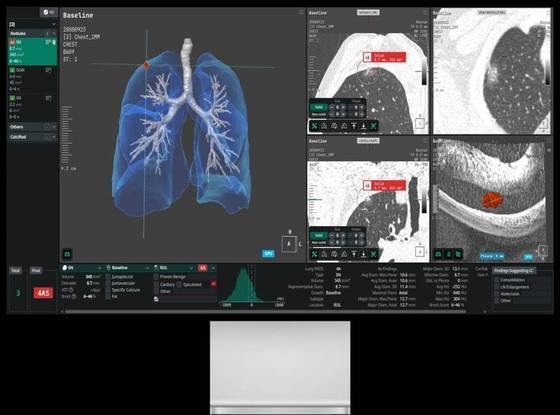
Coreline Soft is pivoting from a one-time revenue model to a subscription-based (SaaS) business structure.
This strategic shift coincides with the company’s foray into the European medical screening market, signaling a new phase of medium to long-term growth.
Industry sources reported on Monday that Coreline Soft, founded in September 2012 by three Korea Advanced Institute of Science & Technology (KAIST) alumni who are pioneers in Korean medical imaging research, is an artificial intelligence (AI) driven medical imaging solutions provider. The company made its debut on the KOSDAQ market in 2023 through a technology-based special listing.
Medical imaging, crucial for disease diagnosis, encompasses various technologies such as computed tomography (CT), magnetic resonance imaging (MRI), X-ray, ultrasound, and mammography. Coreline Soft’s expertise lies in CT image analysis. The company’s revenue streams are divided between the CapEx model, which recognizes revenue upfront when implementing AI diagnostic software in hospitals and government agencies, and an annual subscription model.
While the CapEx model dominates in domestic and European markets, U.S. and Japanese markets favor monthly or annual subscription models. Recently, the focus has shifted from short-term revenue figures to the qualitative transformation of revenue structures.
Notably, as dependence on public AI vouchers decreases and hospitals increasingly adopt long-term contracts voluntarily, the revenue structure is steadily transitioning towards a more stable, private demand-driven model.
The share of SaaS revenue expanded from 29% in 2022 to 45% last year, with projections exceeding 50% this year. Despite the challenges typically associated with transitioning to a SaaS model, overall revenue growth has remained robust, indicating an expanding user base and strong growth potential.
This year, expectations are high for a significant boost in overseas revenue as European national screening programs begin to impact financial results.
In Germany, major university hospitals are increasingly adopting Coreline Soft’s solutions. The potential inclusion of lung cancer screenings in health insurance coverage could establish a stable demand base.
In France, the company has secured access to public hospitals through the public procurement system, while the UK is expanding its national screening programs. Industry analysts note that the European market is evolving beyond mere technological validation to focus on policy infrastructure competition.

Domestic Market: Expanding Institutional Integration and Real-World Data Accumulation
In South Korea, Coreline Soft continues to make strides in institutional integration. Their cerebral hemorrhage diagnostic aid solution, designated as an innovative medical technology, is seeing increased use in the non-reimbursed market. Additionally, their flagship product has been classified as a new medical technology subject to evaluation deferral, enabling its application in clinical settings.
These developments are bolstering the company’s ability to accumulate real-world data (RWD).
Coreline Soft’s competitive edge lies in its successful policy integration and recurring revenue model. Inclusion in national screening programs ensures long-term, stable demand, making institutional adoption and operational success more critical than raw revenue figures.
As SaaS revenue grows and recurring income from national screenings gains momentum, coupled with the accumulation of RWD from evaluation deferrals in Korea, both the quality of revenue and growth rates are expected to improve.
An industry insider emphasized that Coreline Soft’s key strengths are its policy integration and recurring revenue structure. Incorporation into national screening programs generates long-term, stable demand. The focus should be on successful integration and operational effectiveness rather than just revenue numbers.