

I aimed to broaden treatment options for pet owners to prevent regrets.
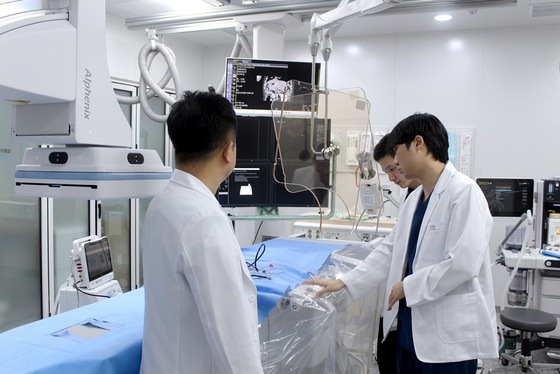
Helix Animal Medical Center in Seocho, led by Chief Director Hwang Jeong-yeon, recently unveiled its Intervention Center and introduced the cutting-edge vascular imaging system, Canon Alphenix Sky.
Pet parents seeking tumor treatments for their dogs and cats often search for additional options. Particularly when surgery is challenging or tumors recur, both pets and their owners face a critical decision point. To help these owners make informed choices without missing crucial treatment windows, Helix has once again made a bold investment.
Treatment Without Invasive Surgery… Creating a Precise Intervention Environment
Since 2019, Helix has pioneered tumor treatment by introducing South Korea’s first radiation therapy equipment for pets.
With the launch of the Intervention Center, Helix has established a foundation for designing more diverse and flexible treatment strategies within the framework of tumor surgery, chemotherapy, and radiation therapy. It has achieved a milestone as the first animal hospital in the country to offer both radiation therapy and interventional procedures under one roof.
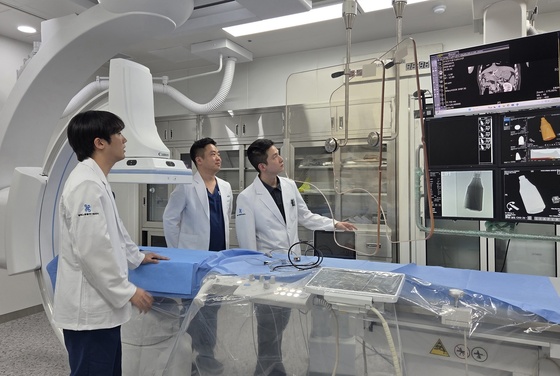
The newly acquired Canon Alphenix Sky enables real-time visualization of blood vessels while simultaneously conducting treatment. It features computed tomography (CT) capabilities, allowing the creation of three-dimensional (3D) vascular maps during procedures.
Compared to traditional C-arm equipment, it reduces radiation exposure while delivering sharper images. The key advantage is the ability to perform minimally invasive treatments by directly viewing lesions without open surgery.
In an interview with News1, Dr. Kim Tae-sung explained that tumor treatment rarely resolves with a single approach. By introducing interventions, we can now offer pet owners another viable treatment option.
He emphasized that it’s like switching from navigating with a paper map to using advanced global positioning system (GPS). This visual treatment environment has significantly improved both the accuracy and safety of the procedures.
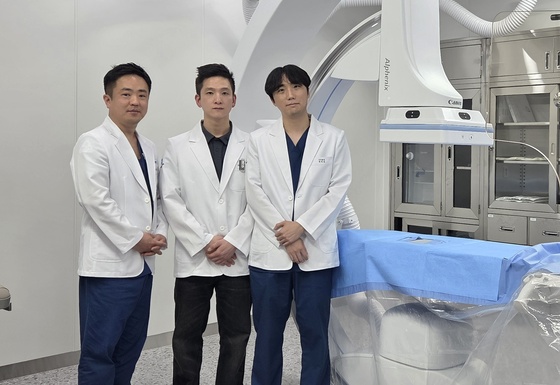
Dr. Jeong Jeong-yoon, a veterinary radiology specialist from Konkuk University, has joined as the head of the Intervention Center. Interventional techniques can be applied not only to tumors but also for biopsies, angioplasty, stent placements, and various conditions affecting the brain, gastrointestinal tract, and urinary system.
Dr. Jeong noted that previously, it often relied on 2D images and experience for procedures. With this new equipment, it can now approach cases much more precisely using 3D vascular maps. Even with familiar treatments, it’s moving towards more accurate methods that are less taxing on the animal patients.
Are There No Other Options?… Expanding Tumor Treatment Choices
The most notable application of this new equipment is tumor embolization. This technique selectively blocks blood vessels feeding tumors, inhibiting their growth. It can be performed without open surgery, which is particularly significant for elderly animals or those facing high surgical risks, providing alternatives beyond traditional surgery.
Embolization can be used not only as a standalone treatment but also in combination with other therapies. It can be applied to reduce tumor size before surgery or as an additional treatment following other interventions.
Dr. Go Jae-eun, who leads Helix’s Seoul Animal Imaging Tumor Center, shared her experiences from the field:
Many dogs and cats return after tumor treatment only to face recurrence. When owners ask, Is there nothing more we can do? it deeply resonates with Dr. Go.
She continued that she’s seen many heartbreaking cases where options are limited for recurrent patients. Interventions can offer another way to control tumors and help pets live more comfortably, even if a complete cure isn’t possible.
Dr. Jeong emphasized that interventional treatments involve minimal incisions and shorter anesthesia times, reducing patient stress. For pet owners, knowing there’s one more option to try can be incredibly reassuring.
Hybrid Establishing a Lead Surgical Suite… Strengths of Multidisciplinary Care
Alongside the new equipment, Helix has also established a Hybrid Surgical Suite. This space can simultaneously accommodate brain navigation-based interventions and surgical procedures. If unexpected situations arise during treatment, immediate surgical transitions are possible.
Another significant aspect of the Intervention Center is the completion of multidisciplinary care. Helix integrates radiology, surgery, internal medicine, oncology, and radiation therapy within a single facility, providing a 24-hour one-stop system from diagnosis to procedures and emergency surgeries.
Treatment sequences and methods can be customized for each patient, whether dog or cat. Considering both the patient’s condition and the owner’s circumstances, a team of specialized veterinary professionals designs the optimal treatment plan, which is a key reason clients trust Helix.
Dr. Kim Tae-sung stated that tumor treatment isn’t solved by a single discipline; it’s a collaborative art form involving multiple fields. With the addition of interventions, it can now make quicker decisions on treatment strategies that include Plan B and Plan C.
Dr. Go also noted that the ability to determine treatment direction in one place without moving between multiple animal hospitals is a significant advantage for both owners and patients. Since timing is crucial in tumor treatment, this also greatly enhances the speed of decision-making.
Helix Animal Medical Center views the opening of this Intervention Center as a new turning point that transcends traditional tumor treatment frameworks.
Dr. Kim concluded that they’ve been contemplating what’s needed after radiation therapy, and interventions are the answer. It’ll continue to be a hospital that offers the best choices for patients through an expanding range of treatment options.