

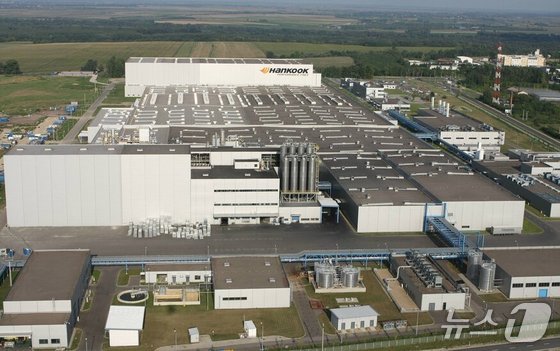
The South Korean tire industry, which achieved record-breaking sales last year, is expected to maintain its strong performance in the first quarter of this year. Operating profits are projected to increase by over 40% compared to the previous year, driven by continued growth in high-value product sales, including tires for electric vehicles and sport utility vehicles (SUVs).
However, the ongoing U.S.-Iran conflict is likely to impact raw material and shipping costs, with these increases expected to be fully reflected in the second half of the year. The industry’s ability to sustain its growth trajectory remains uncertain, hinging on whether companies can successfully pass these cost hikes on to consumers through price adjustments.
Korean tire giants see robust Q1: Hankook’s operating profit up 42% to 500 billion KRW (about 339 million USD), Kumho at 146 billion KRW (about 99 million USD), Nexen reaches 57.5 billion KRW (about 39 million USD)
Financial data provider FnGuide reported on April 23 that the consensus forecast for Hankook Tire & Technology’s first-quarter operating profit stands at 502.8 billion KRW (about 341 million USD), representing a 41.8% year-over-year increase.
Nexen Tire is also expected to post strong results, with analysts projecting a 41.31% surge in operating profit to 57.5 billion KRW (about 39 million USD). Meanwhile, Kumho Tire, still grappling with the aftermath of a fire at its Gwangju plant, is anticipated to maintain profitability at around 146.2 billion KRW (about 99 million USD), roughly on par with last year’s figures.
Kumho Tire’s performance has been relatively subdued due to ongoing production disruptions stemming from the fire. Since the incident at its Gwangju facility in May last year, the company has been actively pursuing relocation efforts to a new plant in Hampyeong.
Collectively, the three major tire manufacturers achieved record-breaking combined sales of 18.2 trillion KRW (about 12 billion USD) last year, marking significant growth. Industry observers anticipate this positive momentum to carry forward into the first quarter of this year.
The robust first-quarter performance can be attributed to several factors, including increased sales of larger tires driven by the growing popularity of SUVs and a surge in demand for electric vehicle tires. Notably, tires designed for electric vehicles require advanced technology to withstand the additional weight of batteries and cope with high instantaneous acceleration.
Hankook Tire has seen its share of electric vehicle tires rise dramatically, from 15% in 2023 to 27% last year. Europe, where the transition to electric vehicles is accelerating rapidly, is emerging as a key driver of growth in the tire market.
Kim Kyu-yeon, an analyst at Daishin Securities, commented on Hankook Tire’s performance, noting that the company likely benefited from stable demand in the replacement tire market, particularly in Europe. Additionally, favorable EUR exchange rates and strategic price increases are expected to have bolstered their overall financial performance.
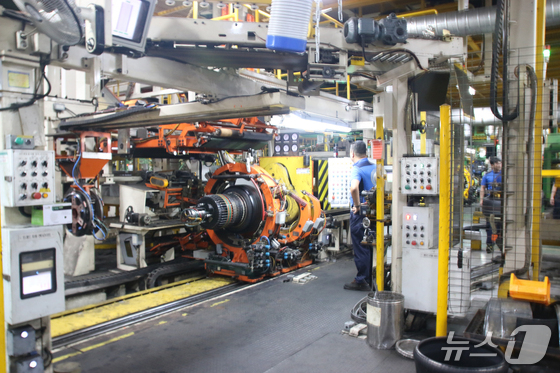
Looming Challenges: Rising Raw Material and Shipping Costs Set to Impact Profitability From Late Q2
Despite the strong start to the year, the industry’s outlook beyond the first quarter remains uncertain. The escalating U.S.-Iran tensions have triggered a broad increase in petrochemical product prices, intensifying cost pressures for tire manufacturers.
Bloomberg and Eugene Investment & Securities report that the price of butadiene, a crucial raw material for tire production, reached 2,375 USD per ton as of April 20. This marks a staggering 95.5% increase from 1,215 USD just three months prior. Butadiene, a byproduct of ethylene production derived from crude oil, is essential for manufacturing styrene-butadiene rubber (SBR), a key component in tire production.
Escalating shipping costs present an additional challenge. The Shanghai Containerized Freight Index (SCFI), a benchmark for global container shipping rates, climbed to 1,886.54 last week, representing a 41.5% surge from 1,333.11 at the outbreak of the conflict.
Industry analysts predict that the full impact of war-related cost increases will begin to materialize in the latter half of the year as existing inventories are depleted. The ability of tire companies to pass these heightened costs onto consumers through price adjustments will be crucial in maintaining their financial performance.
Jang Moon-soo, a research analyst at Hyundai Motor Securities, offered his perspective: It anticipates profitability to remain robust through the second quarter, benefiting from the lingering effects of lower raw material and shipping costs. However, the rising costs stemming from Middle East tensions are likely to start impacting margins from late Q2, with a slight delay due to inventory cycles.
On a more optimistic note, Jang suggested that if tire manufacturers can implement industry-wide price increases to offset margin pressures related to the Middle East situation, and if costs stabilize following the resolution of the conflict, future profit projections for the sector could potentially be revised upward.