

A groundbreaking three-dimensional (3D) printing technology has been unveiled, capable of producing small three-dimensional structures every minute.
On Wednesday, a research team led by Professor Jeong Im-doo from the Department of Mechanical Engineering at Ulsan National Institute of Science and Technology (UNIST) announced the development of Dispensing Volumetric 3D Manufacturing technology. This innovative method enables rapid production of entire shapes at once, departing from the layer-by-layer approach of conventional 3D printing.
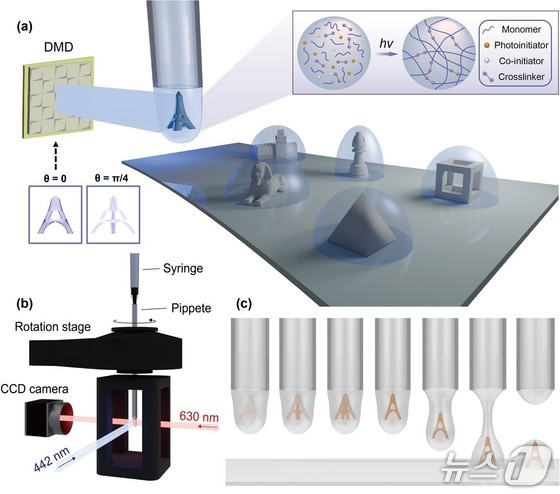
The technique involves using light to solidify liquid material droplets formed at the tip of a pipette into desired shapes.
Once a droplet solidifies, air pressure expels it from the pipette, immediately followed by the formation of a new droplet to continue the production process.
This method significantly reduces production time compared to existing 3D printing technologies and eliminates the need for post-processing to smooth out layers.
While similar technologies existed previously, they required separate containers for liquid materials and additional steps, making continuous mass production of multiple components challenging.
The research team developed DVAM technology, which enables printing and dispensing within the liquid droplets ejected from the pipette, effectively using the droplet itself as the printing volume.

The team overcame the challenge of light refraction caused by the droplets’ curved surfaces by employing artificial intelligence.
The artificial intelligence (AI) system recognizes the droplets’ curvature and contour in real-time, calculates light refraction paths, and projects a pattern that corrects distortion and adjusts the energy required for solidification.
This technology can create complex structures like the Eiffel Tower or Rodin’s The Thinker in under 10 minutes, with each structure taking approximately one minute to produce.
Professor Jeong, who led the research, explained that by moving beyond traditional photopolymerization methods to produce entire volumes at once and addressing optical distortion limitations through AI, they’ve significantly advanced the potential of ultra-fast 3D printing.
The research findings were published online on March 21 in the prestigious materials science journal Advanced Functional Materials. The study received support from the Ministry of Science and Information and Communications Technology (ICT), the National Research Foundation of Korea, the Institute of Information and Communications Planning and Evaluation, and the Ministry of Trade, Industry and Energy.