

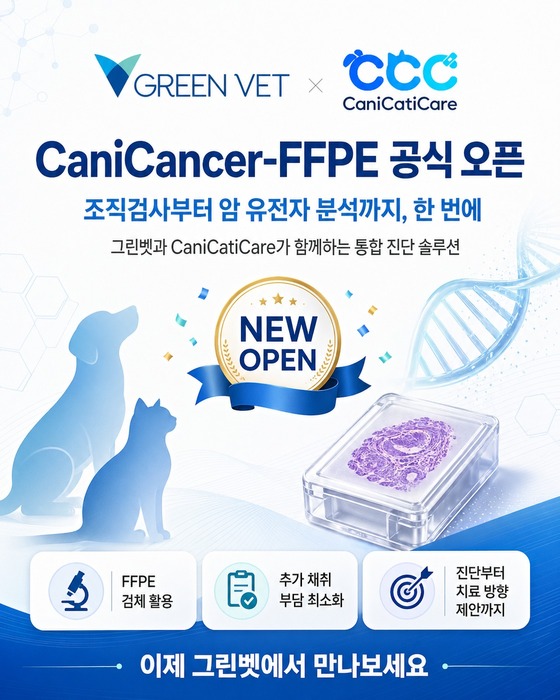
A groundbreaking diagnostic approach has emerged, addressing the limitations of repeated sampling and dispersed testing in pet tumor diagnosis.
GreenVet, a leading pet diagnostics firm, has announced its official distribution of CaniCancer-FFPE, an innovative cancer precision diagnostic solution developed by CaniCatiCare, a specialized pet oncology company led by Chief Executive Officer (CEO) Hong Jae-woo. This advancement establishes an integrated diagnostic framework, seamlessly connecting tissue biopsies and genetic testing into a unified process.
According to GreenVet’s statement on Thursday, traditional methods required separate procedures for tissue biopsies and genetic tests for chemotherapy selection. Tumor samples had to be divided: some sent as formalin-fixed specimens for pathological diagnosis, while others were dispatched as fresh tissue to different facilities for genetic analysis.
This fragmented approach often resulted in inconsistencies due to varying sample conditions, affecting test suitability and leading to disjointed result interpretations. The referral process was complex, and for smaller tumors, conducting tests was often challenging.
The new model streamlines this structure. Its key innovation lies in the ability to extend the use of a single tissue sample from biopsy to genetic testing.
Notably, this method enables gene analysis from formalin-fixed tissues, eliminating the need for separate fresh tissue collection or rapid transport. Test requests and result verifications are now integrated into a single, cohesive system.
CaniCatiCare CEO Hong explained that when a pet is diagnosed with cancer, the immediate question for both owners and veterinarians is What treatment should we pursue? CaniCancer-FFPE dramatically reduces the time to answer this by combining tissue biopsy and genetic analysis in one request.
The clinical impact is significant. By eliminating the need for additional tissue sampling, the method reduces anesthesia risks and invasive procedures for pets. Even for tumors that have spread to challenging areas like the lungs or abdominal cavity, testing can proceed using existing samples without additional surgery.
For pet owners, this translates to a simplified testing process and faster treatment decisions.
GreenVet’s foresight in storing tissue samples from the past five years in DNA-analysis-compatible formats now allows for genetic testing on previous biopsy patients without additional surgeries. This capability is crucial for reassessing treatment strategies in cases of recurrence or metastasis based on existing data.
CaniCatiCare reports that the CaniCancer test analyzes seven key cancer-related genetic mutations, guiding the selection of targeted therapies based on specific mutation types. This integration of morphological tissue diagnosis with genetic information creates a comprehensive framework from diagnosis to treatment strategy formulation.
The innovation is set to transform hospital operations as well. The previous need for additional explanations and re-referrals after tissue biopsies is now streamlined into a single, expandable testing workflow. This is expected to boost both test conversion rates and overall clinical efficiency.
A GreenVet spokesperson stated that by distributing CaniCancer, they’ve enhanced the continuity of diagnosis based on tissue biopsy data. They’re committed to evolving our diagnostic infrastructure beyond just providing test results to actively supporting clinical decision-making.