

![North Korean leader Kim Jong Un. [For Use Only in the Republic of Korea. Redistribution Prohibited] / Courtesy of News1](https://contents-cdn.viewus.co.kr/image/2026/04/CP-2022-0006/image-6796c5bb-c7e5-4aab-827c-c3b31eebcbc7.jpeg)
An analysis has found that North Korea’s public executions have been restructured into a core tool of regime control following the COVID-19 pandemic.
According to a report titled “Mapping Killings Under Kim Jong Un: North Korea’s Response to the COVID-19 Pandemic,” released April 28 by the Transitional Justice Working Group (TJWG), a human rights documentation organization, a total of 144 executions and death sentences were confirmed from the start of Kim Jong Un’s rule in December 2011 through December 2024, with at least 358 people executed. The report was based on interviews with 880 North Korean defectors over the past decade, along with coverage from North Korea-focused media outlets.
Sharp rise in executions for “control violations” such as exposure to outside culture
The report said public executions were concentrated during specific periods, particularly in the early years of Kim’s rule from 2012 to 2014 and during the COVID-19 period from 2020 to 2021. In 2020, at the onset of the pandemic, 24 public executions were carried out, marking the highest annual total.
The reasons for executions have also shifted significantly. Before COVID-19, public executions were primarily used to punish general criminal offenses such as murder. Afterward, however, individuals were executed for actions considered violations of regime control, including consuming foreign culture, criticizing the system, engaging in religious activities or breaching quarantine measures.
Executions and death sentences related to foreign cultural exposure increased from four cases before the pandemic to 14 cases after, while political crimes rose from four to 13. In contrast, executions for murder decreased from nine to five.
The locations of executions also expanded from eight areas to 19, suggesting that what had once been limited to specific regions has spread nationwide, functioning as a tool of fear-based control over the population.
These changes are also linked to legal and institutional developments. Since 2020, North Korea has enacted a series of laws, including the “Law on Rejecting Reactionary Ideology and Culture,” the “Youth Education Guarantee Law,” the “Pyongyang Cultural Language Protection Law,” and in 2023, the “State Secrets Protection Law,” creating a framework to strictly punish the inflow, spread and leakage of external information.
The report noted that such controls have been particularly focused on the so-called “jangmadang generation,” which is more familiar with outside culture. This creates a paradox, as many in the youth population — often promoted by the regime as the “future generation” — belong to this group.
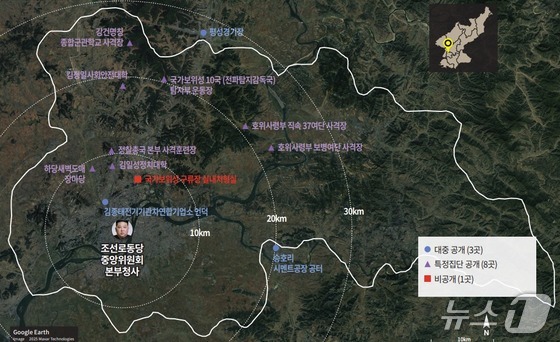
text under image: Classification of execution types across 12 execution sites in and around Pyongyang. (Captured from TJWG report)
Amnesty International said in February, based on in-depth interviews with 25 North Korean defectors, that residents, including high school students, were publicly executed for watching or distributing the South Korean-produced Netflix series “Squid Game.”
The organization said public executions are used as a method of control designed to instill fear, with tens of thousands of students and residents reportedly forced to attend execution sites. It described this as a representative case of forcing even minors to witness executions, internalizing fear and using collective trauma as a tool of control.
The BBC also reported in June 2024 and February this year that North Korea is waging what it described as a “war on Korean wave content.” While noting cases of young people being publicly executed for distributing South Korean content, the BBC said authorities appear to select specific individuals as examples rather than punish all violators, maximizing the deterrent effect through fear.
Park Won-gon, a professor of North Korean studies at Ewha Womans University, said that with legal and institutional measures such as the anti-reactionary ideology law making the blocking of outside culture a central control task, selective, example-setting executions targeting young people may have been carried out.
He added that amid worsening economic conditions and rising public discontent, the Kim Jong Un regime has likely strengthened fear-based control measures, warning that while the inflow of outside culture may not immediately lead to regime collapse, it could pose a long-term challenge to North Korea’s system.