

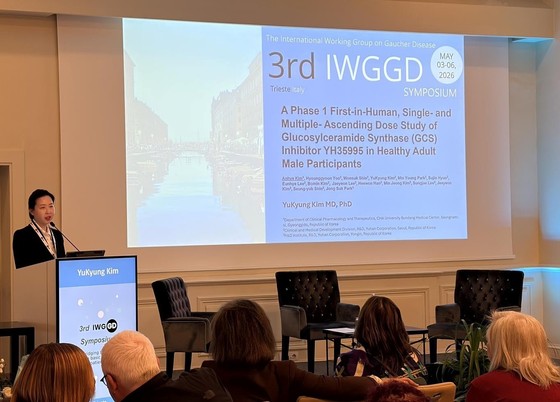
Yuhan Corp. said its investigational Gaucher disease treatment candidate YH35995 demonstrated dose-dependent efficacy and long-lasting activity in a Phase 1 clinical trial.
The company said Thursday that it presented results from the single ascending dose (SAD) portion of the Phase 1 trial for YH35995, a glucosylceramide synthase (GCS) inhibitor, during an oral presentation at the 3rd International Working Group on Gaucher Disease (IWGGD) Symposium 2026 held in Trieste, Italy, on May 6.
According to the findings, YH35995 showed dose-proportional increases in systemic drug exposure with low interpatient variability in pharmacokinetic analyses.
Notably, the orally administered therapy demonstrated a long half-life of about 21 to 24 days, an uncommon feature for oral drugs, supporting its potential as a long-acting treatment.
From a pharmacodynamic perspective, plasma GL1 — a key biomarker — decreased in a dose-dependent manner. The fourth and fifth dose cohorts achieved target inhibition rates, confirming strong and sustained GL1 suppression.
Based on the results, the company said dosing intervals of four weeks or longer may be feasible.
YH35995 is an oral small-molecule GCS inhibitor belonging to the substrate reduction therapy (SRT) class. The pipeline was secured through a 2018 joint research agreement with GC Biopharma, while Yuhan is currently leading clinical development independently.
One of the drug candidate’s key advantages is its ability to cross the blood-brain barrier (BBB).
The BBB is a protective structure that restricts substances in the bloodstream from entering the brain, and the inability of most drugs to penetrate it has been a major obstacle in treating central nervous system disorders.
Gaucher disease is a rare inherited disorder caused by mutations in the GBA1 gene, resulting in the accumulation of glucosylceramide (GL1) in the body.
In neuronopathic Gaucher disease, unmet medical needs remain high because existing treatments have limited BBB penetration.
Based on the SAD findings, Yuhan plans to conduct a multiple ascending dose (MAD) trial to evaluate safety and tolerability under a four-week dosing regimen. The company also plans to assess changes in GL1 levels in plasma and cerebrospinal fluid (CSF), as well as target engagement within the central nervous system.