

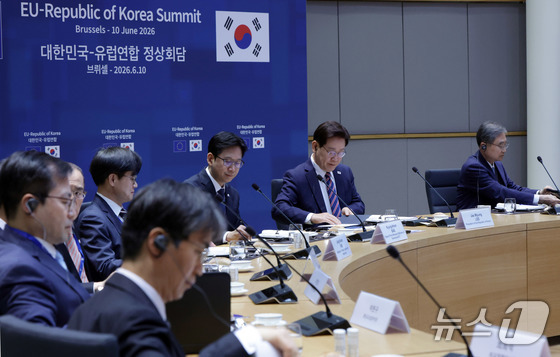
President Lee Jae Myung took a strong diplomatic stance in the joint statement from the summit with the European Union (EU) on Wednesday, condemning the military cooperation between North Korea and Russia and reaffirming the principles of North Korea’s denuclearization. This move is likely to elicit a sensitive reaction from Pyongyang.
Analysts suggest that the government has assessed the difficulty in changing North Korea’s advancing nuclear and missile capabilities and its deepening ties with Russia and China in the short term. Consequently, they believe strengthening diplomacy with the international community currently offers more tangible benefits than focusing solely on North Korea policies.
South Korea and EU Strongly Condemn North Korea-Russia Military Cooperation, Demand North Korea’s Compliance with Non-Nuclear State Obligations
On Wednesday, the government held the 11th South Korea-EU summit in Brussels, Belgium, releasing a joint statement that declared that it strongly condemns the illegal military cooperation between Russia and North Korea, and urge both countries to immediately cease all related activities and comply with the UN Charter and all United Nations (UN) Security Council resolutions.
The statement expressed serious concerns about North Korea’s nuclear and ballistic missile programs, reaffirming the commitment to complete denuclearization of the Korean Peninsula in line with UN Security Council resolutions. It also specified that North Korea must comply with its obligations as a non-nuclear weapons state under the Non-Proliferation Treaty (NPT) and implement comprehensive safeguards agreements with the International Atomic Energy Agency (IAEA).
Notably, the joint statement emphasized that North Korea cannot be recognized as a nuclear weapons state under the NPT and cannot hold any special status. Diplomatic observers noted that this statement contains the strongest language yet regarding the North Korean nuclear issue and military cooperation with Russia since the Lee administration took office.
Since its inauguration, the Lee administration has prioritized restoring inter-Korean relations while minimizing public criticism or pressure on North Korea that could provoke a reaction. The government initiated policies to avoid provoking North Korea, including controlling anti-North Korean leaflet distribution and suspending loudspeaker broadcasts and psychological warfare operations. However, the tone of the joint statement with the EU suggests a significant shift in this approach.
Government Shifts Focus to International Alignment, Acknowledging Prolonged Timeline for North Korea Dialogue
Analysts speculate that the government has escalated its North Korea messaging due to the institutionalization of close ties between North Korea and Russia over the past three years, formalized through various agreements. They also note the recent summit between North Korea and China, which marked a significant deepening of ties, as a factor in this shift.
Given North Korea’s ongoing hostile posture and escalating nuclear and missile threats, the government finds it challenging to identify factors that could lead to rapid changes in relations. In this context, they interpret that strengthening international cooperation is currently more advantageous for pragmatic diplomacy.
During his summit with Kim Jong Un on Monday, Chinese President Xi Jinping stated that they must oppose hegemony and coercive politics, indicating that North Korea and China should coordinate their responses to U.S. actions. After reinforcing cooperation with Russian President Vladimir Putin last month, Xi’s meeting with Kim created an environment where North Korea has no incentive to halt its hardline stance.
Xi’s indication of pursuing military cooperation with North Korea raises concerns that such ties could be interpreted as recognizing North Korea’s nuclear weapons state status, further diminishing the chances of North Korea engaging in dialogue.
Analysts view China’s actions as an effort to expand its influence over North Korea amid deepening strategic competition with the United States, aiming to secure leadership in Northeast Asia.
Just before Xi’s visit, North Korea reaffirmed its hardline stance on its nuclear status. On June 7, Kim Yo-jong, Kim Jong Un’s sister, asserted that its status as a nuclear weapons state is non-negotiable, regardless of who acknowledges it; it is an undeniable reality.
Kim Jong Un’s inspection of a new uranium enrichment plant on June 3 and a ballistic missile production facility on June 6 subtly conveyed that China tacitly acknowledges North Korea’s nuclear weapons state status.
The South Korean government appears to be leveraging the current situation to align its perception of North Korea with Europe’s and expand security cooperation with European countries.
Hong Min, a senior researcher at the Korea Institute for National Unification, commented that given the close ties between North Korea, Russia, and China, and the advanced state of North Korea’s nuclear program, addressing these issues has become increasingly complex. This reflects the need to closely align with the U.S. and Western countries to implement the South Korea-U.S. agreement.
Joint Statement May Boost Defense Industry Cooperation with Europe, Potentially Influencing Canadian Submarine Deal
The joint statement is seen as a strategy to increase European interest in South Korean defense industries by demonstrating South Korea’s commitment to European security issues. This approach may also positively influence Canada’s 60 trillion KRW (about 39.2 billion USD) next-generation submarine procurement project, given Canada’s close ties with the North Atlantic Treaty Organization (NATO) members.
However, the joint statement is likely to provoke an immediate backlash from North Korea, potentially putting a temporary halt to the implementation of North Korea policies.
The Kim Jong Un regime, characterizing the recent international situation as a new Cold War, has adopted strategic alliances with China and Russia as its core survival strategy. They have shown particular sensitivity to denuclearization efforts and non-recognition of their nuclear status, viewing these as infringements on their sovereignty.