

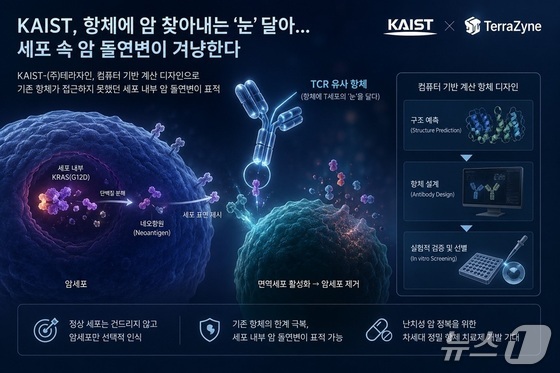
On Friday, researchers at the Korea Advanced Institute of Science and Technology (KAIST) announced a breakthrough in cancer treatment. A team led by Professor Oh Byung-ha from the Department of Life Sciences, in collaboration with protein design startup Terazine, has developed an antibody that specifically targets cancer cells carrying the KRAS(G12D) mutation.
The KRAS(G12D) mutation affects the KRAS protein, which plays a crucial role in regulating cell growth and division. This mutation is frequently observed in pancreatic, colorectal, and lung cancers. Until now, the KRAS protein has been considered an undruggable target due to its location inside cells, making it inaccessible to conventional antibody therapies.
The scientists focused on the cell’s natural protein degradation process. During this process, the mutated KRAS(G12D) protein is broken down into smaller fragments called neoantigens. Some of these fragments migrate to the cell surface, where they can be detected by immune cells.
Using a combination of advanced computational protein design and experimental screening, the team created a T-cell receptor (TCR) mimetic antibody. This antibody can precisely identify only the fragments associated with the cancer-causing mutation.
TCRs are natural detectors on T-cells, our body’s immune cells, that read protein fragments on cell surfaces to identify cancerous or virus-infected cells. The new TCR mimetic antibody essentially gives conventional antibodies the eyes of T-cells, allowing them to selectively recognize traces of intracellular cancer mutations that were previously out of reach.
In laboratory tests, the novel antibody showed remarkable specificity, reacting minimally with normal cells or other proteins while effectively targeting cancer cells with the KRAS(G12D) mutation. When used in immunotherapy experiments, it successfully eliminated only the cancer cells carrying this specific mutation.
The researchers believe this development could revolutionize cancer treatment by expanding the range of targetable proteins to include those inside cells, which have long evaded existing antibody therapies. This breakthrough may pave the way for a new generation of precision antibody treatments against various cancer mutations, not limited to KRAS.
Professor Oh emphasized the significance of their work, stating that they’ve demonstrated the potential for developing highly targeted antibody therapies that minimize collateral damage to healthy cells. The computational antibody design approach could be a game-changer in creating next-generation treatments for a wide range of cancer mutations.
The team is now conducting efficacy tests in animal models of the disease. Their next steps include optimizing the production process for clinical trial samples and further preclinical development, building on the promising results observed at the cellular level.

The study was a collaborative effort by KAIST alumni. Ahn Sang-pil from Terazine served as the lead author, with Professor Oh and Terazine’s Research Director Jeong Bo-seong acting as co-corresponding authors, overseeing the entire research process.
The groundbreaking findings have been published in the online edition of Molecular Therapy, a prestigious international journal focusing on gene and cell therapy.