

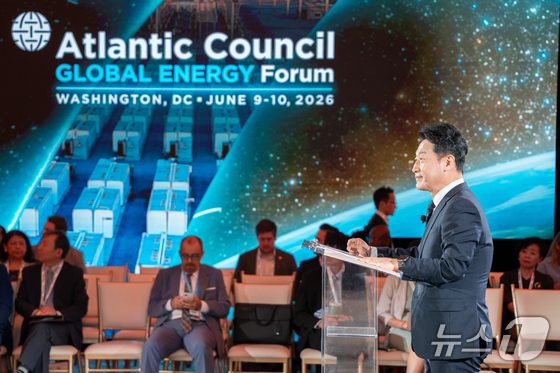
The U.S. Department of Climate, Energy, and Environment reported on Thursday that Deputy Minister Lee Ho-hyun visited Washington, D.C. from June 8 to 10 to discuss strengthening U.S.-Korea energy security cooperation and expanding public-private partnerships in the energy sector.
The visit coincided with the 70th anniversary of the U.S.-Korea nuclear agreement. Both nations reviewed their nuclear cooperation achievements and discussed strategies to address the rising electricity demand driven by artificial intelligence (AI) expansion and energy security challenges.
On Monday, Deputy Minister Lee participated in the 70th Anniversary Conference of the U.S.-Korea Nuclear Agreement, jointly organized by the Atlantic Council and Korea Hydro & Nuclear Power. The event provided a platform to reflect on bilateral nuclear cooperation achievements and explore future directions for next-generation collaboration. Lee emphasized the importance of expanding industrial cooperation across the entire nuclear energy lifecycle, adhering to non-proliferation principles.
The following day, Lee delivered a keynote address at the Atlantic Council’s 10th Global Energy Forum, focusing on Power Security in the Era of Electrification. He highlighted how the growth of AI data centers and the semiconductor industry has increased electricity demand, introducing new energy security challenges such as power grid resilience, large-scale energy storage systems (ESS), and critical mineral supply chains.
Lee then outlined the South Korean government’s energy security strategy. This includes expanding national power grid investments, securing gigawatt-scale ESS, implementing long-term contracts and flexible markets, reforming power governance, and fostering international cooperation on critical mineral supply chains.
On Wednesday, the final day of his visit, Lee co-hosted the U.S.-Korea Energy Business Forum with the U.S. Department of Energy. The forum saw participation from major Korean companies including Korea Electric Power Corporation, Korea Hydro & Nuclear Power, LG Energy Solution, Samsung Heavy Industries, Hyosung Heavy Industries, LS Electric, LS Cable, and Doosan Enerbility.
U.S. participants included representatives from JPMorgan, ExxonMobil, GE Vernova, NextEra Energy, the Electric Power Research Institute (EPRI), and the California Independent System Operator (CAISO). Attendees engaged in discussions on power grids, ESS, energy supply chains, and investment cooperation strategies.
Deputy Minister Lee also toured the Equinix data center in Virginia. The visit focused on discussing power efficiency improvements, high-efficiency cooling technologies, and eco-friendly operational strategies to address the increased electricity demand from AI data centers.