

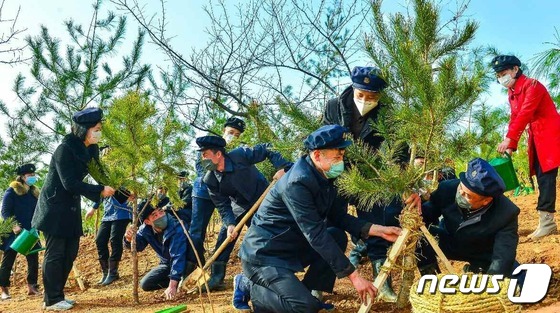
Recent research reveals that one-third of North Korea’s forests have been devastated, prompting experts to call for a shift in inter-Korean forest cooperation. This shift aims to move beyond simple afforestation towards a comprehensive climate and carbon neutrality strategy that incorporates greenhouse gas absorption management. As the global community increasingly relies on land use, land-use change, and forestry (LULUCF) as key tools for achieving carbon neutrality, there’s a growing push to expand inter-Korean forest cooperation. This expansion would address national reduction targets (NDC), forest disaster management, and multilateral cooperation agendas.
On Monday, News1 reported that the Korea Forest Service recently released a report titled, Basic Plan for Inter-Korean Forest Cooperation and Step-by-Step Implementation Plan in Response to External Environmental Changes. This report, conducted through the Forest of Peace project, involved researchers from Konkuk University’s Department of Forest and Landscape Architecture.
As of 2018, North Korea’s forest area covered 9.39 million hectares, accounting for 76.3% of its total land area of 12.31 million hectares. While this figure increased by 400,000 hectares from 8.99 million hectares in 2008, the area of degraded forest reached 2.62 million hectares, representing about 28% of the total forest.
North Korea’s standing timber volume was only 64 cubic meters per hectare in 2020, a mere 40% of South Korea’s level. A 2022 analysis of satellite images from 11 regions showed a deforestation rate of 23.2%. Though lower than the 37.9% recorded in 2008, ongoing damage persists in forest edges adjacent to farmland, pastures, and residential areas, as well as on steep slopes.
The Korea Forest Service’s report highlighted that this issue is intertwined with South Korea’s own challenges in land use, land-use change, and forestry (LULUCF).
LULUCF is a sector that calculates greenhouse gas emissions and absorption resulting from forests, soils, and land use changes. As countries work towards carbon neutrality, managing absorption sources has become as crucial as reducing emissions. South Korea faces an urgent need to conserve existing forest absorption sources and develop new ones to meet its 2030 Nationally Determined Contribution (NDC) and 2050 carbon neutrality goals.
The domestic conditions for absorption sources in South Korea are challenging. Factors such as aging forests, wildfires, and land conversion are reducing absorption levels. The government projects that national greenhouse gas emissions for 2024 will total 691.58 million tons, with absorption at 40.16 million tons, a 1.8% increase from the previous year. However, achieving the 2030 NDC requires an additional reduction of about 200 million tons, which will intensify policy pressure on managing absorption sources.
The report outlines a vision for inter-Korean forest cooperation: Opening an Era of Peace and Prosperity through the Restoration of the Korean Peninsula’s Forest Ecosystem. It aims to enhance sustainability, scalability, and stability. To achieve this, the report proposes three main strategies, eight key tasks, and 17 detailed sub-tasks, focusing on robust domestic cooperation, scalable multilateral cooperation, and prompt, mutually beneficial inter-Korean collaboration.
The initial restoration targets include three areas: Pyongyang, Kaesong, and Goseong. The plan proposes planting trees on 3,000 hectares in urgent need of restoration in the short term. For the medium to long term, it suggests gradually restoring 47,000 hectares of degraded forest on slopes exceeding 15 degrees.
Modernizing nurseries is also crucial. Out of 140 nurseries in North Korea, only 17 are modern, representing just 12%. The report recommends starting with Pyongyang, Kaepung, and Goseong, and then modernizing over 200 small-scale, smart nurseries across various cities and counties.
The report suggests that forest restoration and data building can evolve into REDD+ based cooperation projects, aligning with international reduction efforts and multilateral funding opportunities. This approach dovetails with South Korea’s strategy in the LULUCF sector. The initial phase would involve North and South Korean research institutions collaborating with international organizations to establish a comprehensive forest data system for North Korea. This would be followed by pilot projects in priority areas, leveraging connections to multilateral resources.
The report emphasizes that inter-Korean forest cooperation cannot sustain itself if it continues to be interrupted and resumed based on fluctuating political circumstances, as has been the case in the past. It recommends reframing forest restoration as a practical cooperation agenda in the era of climate crisis. This involves linking it to LULUCF responses, joint disaster management, ecological management of border areas, and cooperation with international organizations.