

“I’m tearing it up. The photo. Right now.”
At the 13th and final plenary session of the South-North Joint Nuclear Control Commission on Dec. 17, 1992, then-South Korean chief delegate Gong Ro-myung, who later served as foreign minister, handed a photograph to North Korean Vice Foreign Minister Choe U-jin. The newspaper photo showed portraits of North Korean founder Kim Il Sung and Soviet leader Joseph Stalin displayed side by side.
When Gong presented the photograph, saying it was evidence that the Korean War had been launched through collusion between Kim Il Sung and Stalin, Choe took the photo and immediately tore it up. After Gong asked, “Why are you tearing up a photograph of your great leader?” the North Korean side responded, “You planned this as a provocation. It was deliberate,” and the atmosphere at the meeting quickly became confrontational.
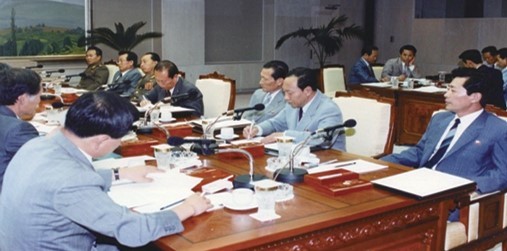
The scene is among the details contained in 3,836 pages of previously undisclosed inter-Korean negotiation records released by South Korea’s Ministry of Unification on Monday. The documents vividly capture North Korea’s views and negotiating logic during nuclear talks held between late 1991 and early 1993. They show Pyongyang blaming South Korea for the outbreak of the Korean War while justifying its nuclear position by citing what it called U.S. nuclear threats. South Korean negotiators countered with Soviet archival documents and previous inter-Korean agreements.
North Korea repeated ‘South invaded first’ claim as Seoul cited Soviet documents
During the 13th meeting of the Joint Nuclear Control Commission, North Korea repeated its longstanding claim that South Korea was responsible for starting the Korean War, placing blame for tensions on the Korean Peninsula on Seoul and Washington. It also argued that continued external nuclear threats justified defensive measures.
Gong responded by citing the memoirs of former Soviet leader Nikita Khrushchev and declassified Soviet diplomatic documents, arguing that Kim Il Sung had prepared for the invasion with Stalin’s backing.
Gong said that “the Khrushchev memoirs and former Soviet diplomatic documents, including the ‘Shtykov telegrams,’ have already been made public,” urging North Korea to stop repeating claims that the South had invaded first. “You should reflect on what truly constituted the criminal act of harming fellow Koreans,” he said. The Shtykov telegrams refer to secret communications exchanged during the Korean War between Stalin and Soviet Ambassador to Pyongyang Terenty Shtykov, containing evidence that the Soviet Union and North Korea coordinated preparations for the war, including Soviet military support.
Sharp divisions over inspections: ‘Why should both sides face equal inspections?’
The newly released records also show that the two Koreas held fundamentally different views on reciprocal inspections following the Joint Declaration on the Denuclearization of the Korean Peninsula.
During nuclear negotiations in late 1991, North Korea pledged to sign a safeguards agreement with the International Atomic Energy Agency (IAEA). In response, South Korea canceled the 1992 Team Spirit joint military exercise with the United States. North Korea signed the IAEA safeguards agreement in January 1992 and accepted its first ad hoc inspections in May and June that year.
The two Koreas brought the Joint Declaration on the Denuclearization of the Korean Peninsula into effect in February 1992, but they never reached agreement on how reciprocal inspections should be conducted. South Korea sought early reciprocal inspections and special inspections, while North Korea demanded inspections of U.S. military bases in South Korea in exchange for allowing inspections of its Yongbyon nuclear facilities. Pyongyang also insisted that U.S. tactical nuclear weapons stationed in South Korea should be subject to inspections.
At the Joint Nuclear Control Commission, launched in March 1992, the two sides remained deadlocked over inspection targets, inspection methods and whether to adopt special inspections.
The North Korean delegation criticized South Korea for agreeing with the United States to resume the Team Spirit exercise, arguing that Seoul “should apologize to the Korean people and pledge never to do so again.”
The North Korean representative also argued that “those who brought in U.S. nuclear weapons and those who did not cannot be inspected equally,” insisting that excluding U.S. military bases from inspections amounted to a biased approach.
South Korea rejected that argument, saying, “The Joint Declaration on the Denuclearization of the Korean Peninsula was not created to facilitate your plans,” while maintaining pressure on the North. When Pyongyang criticized the U.S.-South Korea alliance, the South responded that many countries maintain collective defense arrangements for national security and argued that the U.S.-South Korea alliance itself was established in response to North Korea’s invasion in 1950. The exchanges illustrate that many of the core disputes over the North Korean nuclear issue remain largely unchanged more than three decades later.
The Ministry of Unification said the release of the records provides valuable historical documentation of the adoption of the 1992 Joint Declaration on the Denuclearization of the Korean Peninsula and the subsequent negotiations of the Joint Nuclear Control Commission, offering a detailed look at the issues and negotiations surrounding the nuclear talks between the two Koreas.