

Researchers have made a breakthrough in understanding why immune checkpoint inhibitors, hailed as miracle cancer drugs, are ineffective against certain brain tumors.
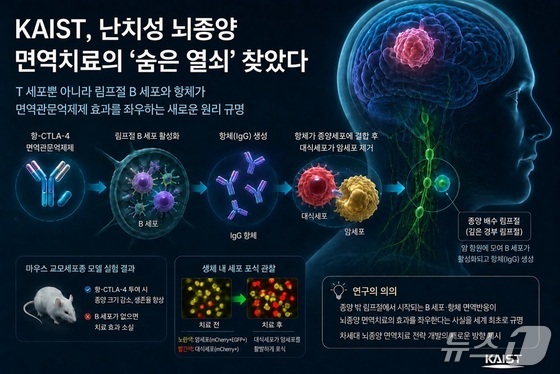
On July 19, the Korea Advanced Institute of Science and Technology (KAIST) announced a groundbreaking discovery by Professor Lee Heung-kyu’s research team from the Department of Biological Sciences. They uncovered a novel immune mechanism where anti-CTLA-4, a type of immune checkpoint inhibitor, activates B cells in tumor-draining lymph nodes to combat brain tumors.
Glioblastoma, a notorious malignant brain tumor, is known for its frequent recurrence and dismal prognosis, even after aggressive treatment with surgery and radiation. While immune checkpoint inhibitors have shown remarkable success in various cancers by reinvigorating immune cell function, their efficacy in glioblastoma has been limited due to the tumor’s highly immunosuppressive microenvironment.
Traditionally, researchers have focused on T cells as the primary target for immune checkpoint inhibitors. B cells, while recognized for their role in antibody production following vaccination, remained largely unexplored in brain tumor immunotherapy. The research team hypothesized that anti-CTLA-4 might also influence B cells.
The experimental results challenged conventional wisdom. In a mouse model of glioblastoma, anti-CTLA-4 administration significantly reduced tumor size and improved survival rates. However, mice lacking B cells showed little to no benefit from the same treatment, indicating that B cells play a crucial role in the therapeutic efficacy of immune checkpoint inhibitors.
The team also pinpointed the site of B cell activity. Surprisingly, B cell responses were most pronounced not in the brain where cancer cells reside, but in the deep cervical lymph nodes connected to the brain.
These lymph nodes exhibited increased activity of germinal center B cells and follicular helper T cells, both critical for antibody response formation. This correlated with a rise in immunoglobulin G (IgG), a key antibody that targets and helps eliminate cancer cells.
The study revealed that these IgG antibodies bind to brain tumor cell surfaces, enhancing macrophages’ ability to destroy cancer cells.
Using an innovative brain tumor model featuring red (mCherry) and green (EGFP) fluorescent proteins, the team successfully observed macrophages actively eliminating brain tumor cells in vivo following immune checkpoint inhibitor treatment.
This research marks the first functional demonstration that B cell immune responses could be a pivotal factor in determining the effectiveness of immunotherapy for resistant brain tumors.
Professor Lee suggested that identifying antibody targets for brain tumors and developing techniques to boost lymph node-based B cell immune responses could lead to next-generation immunotherapy strategies for various cancers, including intractable glioblastoma.
The team plans to investigate whether similar immune responses occur in human glioblastomas and explore optimal combination therapies to enhance treatment efficacy.
The study, led by Professor Oh Ji-eun from KAIST’s Graduate School of Medical Science and Technology, with Dr. Kim Yoo-min as the lead author, was published in the prestigious journal Science Immunology.
This research was supported by various grants from the National Research Foundation of Korea, including the Basic Research Program in Natural Sciences, the Bio-Medical Technology Development Project, the Artificial Intelligence (AI)-Native Advanced Bio Autonomous Laboratory Project, the Doctoral Student Research Grant Program, and the Samsung Future Technology Foundation.