

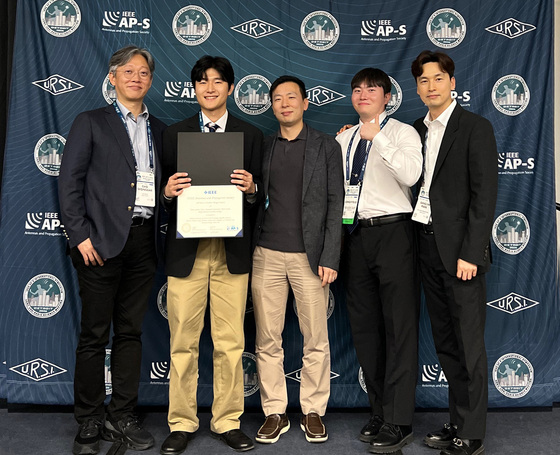
KCC Glass has demonstrated its prowess in future mobility materials technology by clinching the Best Paper Award at an international conference for its innovative vehicle glass-integrated antenna technology, developed in partnership with Pohang University of Science and Technology (POSTECH).
On Monday, KCC Glass revealed that their Antenna on Glass technology for vehicles, co-developed with Professor Hong Won-bin’s research team from POSTECH’s Department of Electrical and Electronic Engineering, secured the top honor at a prestigious international conference. This event was jointly organized by the Institute of Electrical and Electronics Engineers (IEEE) Antennas and Propagation Society (AP-S) and the International Union of Radio Science (URSI).
This achievement marks a milestone as the first time a South Korean company has won the top prize in this industry-academia paper competition. The company emphasized the significance of this accomplishment, noting that they outperformed global industry giants such as Ford and General Motors, Stellantis, Meta, and Lenovo.
The research team tackled a critical challenge in vehicle glass-integrated antennas: surface wave interference. This issue has become increasingly important as demand for such antennas grows with the proliferation of autonomous and connected vehicles. Previously, the expansive glass surfaces and metal components in vehicles were known to generate surface waves that compromised communication performance.
The breakthrough technology leverages the current distribution of a circular patch antenna to suppress surface waves at their source. Notably, this can be achieved using a single metal layer, eliminating the need for complex multilayered structures. KCC Glass explained that this innovation allows for both high transparency and miniaturization, offering superior design flexibility and space utilization compared to conventional external ‘shark fin antennas’ or film-based antennas.
In June, KCC Glass and POSTECH jointly filed a patent for this technology. It has been engineered to be compatible with existing production processes for automotive laminated glass, heated glass, and Low-E glass, enabling mass production without requiring additional equipment investments. The research team also confirmed the technology’s commercial viability through comprehensive 360-degree performance evaluations using actual vehicle windshields.
At the conference, KCC Glass also participated as a panelist in the Future G Summit 2026 autonomous driving session. There, they engaged in discussions on next-generation wireless communication technologies alongside industry leaders such as Tesla and Synopsys, showcasing their vehicle glass-integrated antenna technology.
A spokesperson for KCC Glass stated that vehicle glass-integrated antennas are emerging as crucial communication components in the era of software-defined vehicles (SDVs). It’s not stopping at automotive applications; the vision includes expanding this technology to architectural glass and next-generation electronics.