

A groundbreaking development in artificial intelligence has emerged from South Korea, where researchers have created a next-generation world model capable of theorizing the fundamental principles of reality through observation alone.
On Monday, the Korea Advanced Institute of Science and Technology (KAIST) announced that a research team led by Professor Ahn Seong-jin from the Department of Computer Science has introduced a novel learning paradigm called Theorization Learning (L2T). This innovative approach enables artificial intelligence (AI) to independently formulate theories about how the world operates based solely on observed data. The team has also developed Neural Theorizer (NEO), a neural network-based model that implements this concept.
AI world models are pivotal in various cutting-edge fields, including robotics, autonomous vehicles, generative AI, and autonomous agents. Traditional world models have primarily focused on predicting future events. However, they’ve fallen short in comprehending the underlying mechanisms of the world, even when accurately forecasting immediate outcomes.
Drawing inspiration from human cognitive development, the research team found a solution to this limitation. Humans, from infancy, construct internal theories about the world’s workings to make sense of their environment, even before acquiring language skills. By applying principles from developmental cognitive science, the team has created an AI system that doesn’t just predict the future but truly understands the world’s fundamental operations.
The L2T paradigm proposed by the team takes a unique approach by withholding predetermined answers or rules. Instead, it presents the AI with only the observed results before and after a change occurs. This challenges the AI to deduce independently the underlying rules governing these changes. While previous AI models focused on predicting outcomes, this new approach emphasizes understanding the causality behind observed phenomena.
To bring this concept to life, the team developed NEO, a neural network-based theory generation model. NEO has the remarkable ability to identify hidden rules within observed changes and codify them into actionable principles. These derived rules are versatile, allowing for flexible combination and application across various novel scenarios.
Looking ahead, the research team plans to expand their work by analyzing extended video data to extract fundamental principles and integrate these insights into planning and decision-making processes.
Professor Ahn emphasized the significance of this breakthrough, stating that the research represents a pivotal shift in AI’s world comprehension, moving beyond mere prediction to self-generated explanations of how the world functions. It anticipates this technology will become a cornerstone in diverse fields, from predictive robotics and autonomous agents to AI systems supporting scientific discoveries.
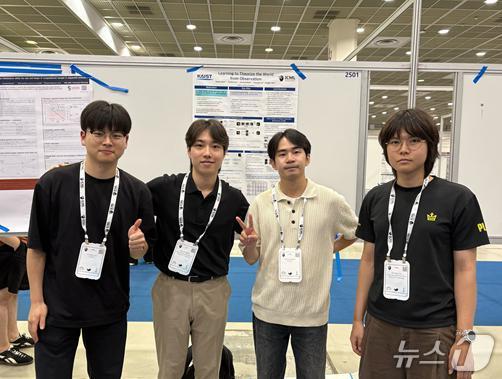
This groundbreaking research, co-authored by Master’s students Baek Du-jin and Lee Kyu-bin from the Department of Computer Science, received recognition at the 43rd International Conference on Machine Learning (ICML 2026) in Seoul, where it was selected for oral presentation. Additionally, it clinched the Best Paper Award at the Constructive Learning Workshop.
The project was made possible through funding from the Overseas Outstanding Scientist Attraction Project and the Overseas Excellent Research Institution Cooperation Hub Project.