

Jeil Pharmaceutical has published clinical phase II results for its oral type 2 diabetes treatment candidate in an international journal, confirming the drug’s blood sugar improvement effects.
On Thursday, Jeil Pharmaceutical announced that a paper detailing the phase II clinical trial results of their in-house developed type 2 diabetes medication, JP-2266, has been published in the Diabetes & Metabolism Journal (DMJ).
DMJ is a respected SCI(E)-indexed international journal focusing on diabetes and metabolic disease research, boasting a recent impact factor (IF) of 8.2.
JP-2266 is a novel dual inhibitor targeting both SGLT-2, which inhibits glucose reabsorption in the kidneys, and SGLT-1, which delays glucose absorption in the intestines. It’s being developed as a next-generation treatment that combines the benefits of existing SGLT-2 inhibitors with improved postprandial blood sugar control.
The clinical trial involved 156 type 2 diabetes patients whose blood sugar remained poorly controlled despite diet and exercise interventions. The study was conducted across 28 medical centers in South Korea, following a randomized, double-blind, placebo-controlled design. Professor Cha Bong-Soo from Yonsei University Severance Hospital served as the clinical trial coordinator.
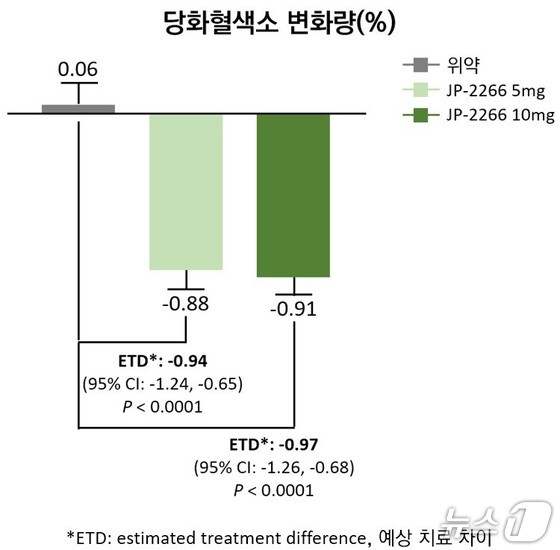
Results showed that after 12 weeks, JP-2266 significantly reduced glycated hemoglobin (HbA1c) compared to the placebo group. The expected treatment difference (ETD) was -0.94% for the 5 mg dose and -0.97% for the 10 mg dose, both achieving statistical significance.
The proportion of patients achieving an HbA1c level below 7.0% was impressive: 70.6% in the 10 mg group and 66.7% in the 5 mg group. Improvements were also seen in fasting blood sugar and postprandial blood sugar at both 1 and 2 hours, with postprandial levels dropping by approximately 63-68 mg/dL at the 12-week mark.
The study also revealed benefits beyond blood sugar control, including weight loss and improvements in cardiovascular and metabolic risk factors. The 10 mg group showed decreased systolic blood pressure and improved markers of insulin resistance and beta-cell function. Safety evaluations indicated that both doses were well-tolerated, with adverse event rates similar to the placebo group.
The diabetes treatment market has recently seen fierce competition in developing next-generation therapies. These new drugs aim to build upon the cardiovascular and renal protective effects of existing SGLT-2 inhibitors while also addressing postprandial blood sugar control.
Industry experts suggest that the dual mechanism of inhibiting both SGLT-1 and SGLT-2 could provide a significant advantage, particularly for Asian patients who typically have high carbohydrate diets.
Professor Cha commented that the SGLT-1 inhibition mechanism, which delays glucose absorption in the intestines, distinguishes JP-2266 from existing SGLT-2 inhibitors. It anticipates this will help mitigate postprandial blood sugar spikes and reduce the strain of rapid insulin secretion on the body.
He cautioned, however, that while these phase II results are promising, further confirmation of efficacy and safety through phase III clinical trials will be necessary.