

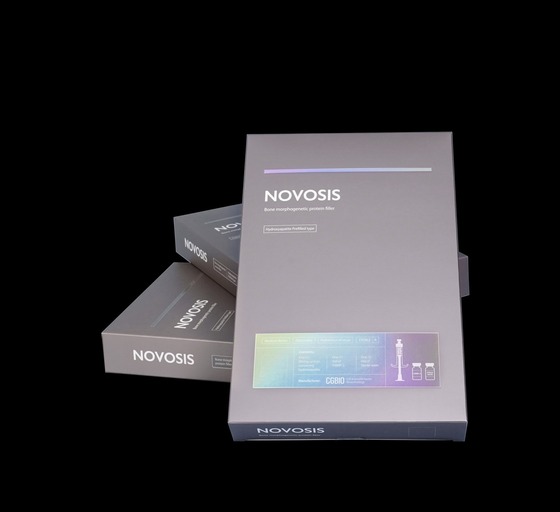
A groundbreaking clinical case utilizing CGBio’s bone substitute Novosis to treat a complex femoral nonunion has been published in a prestigious international journal.
CGBio announced on Wednesday that researchers from Indonesia’s Suharso Orthopedic Hospital successfully treated a patient using Novosis, with their findings featured in the International Journal of Surgery Case Reports.
The case study focused on a 24-year-old male who had failed to achieve bone union despite multiple surgeries and developed a significant 6 cm limb length discrepancy. The surgical team employed an innovative approach, acutely shortening the nonunion site to directly align the bone ends, then applying Novosis at the junction. Subsequently, they gradually restored the leg length through a separate surgical procedure.
Novosis contains rhBMP-2, a potent bone morphogenetic protein. The researchers’ strategy combined mechanical stability through direct bone contact with the regenerative properties of Novosis to promote bone formation.
The treatment yielded impressive results, with initial callus formation observed just two months post-surgery. By the one-year mark, bone union had progressed sufficiently to allow removal of the external fixator. The patient regained pain-free mobility and showed significant improvement in knee joint range of motion.
A 15-month follow-up revealed maintained equal leg length and no major complications.
The research team highlighted this case as a potential breakthrough in treating high-risk nonunion patients with compromised bone healing environments due to repeated surgeries, demonstrating a successful strategy that addresses both mechanical stability and bone regeneration.
Novosis, a cutting-edge bone substitute, combines rhBMP-2 with a hydroxyapatite (HA) based delivery system. CGBio aims to leverage this and other clinical evidence from various countries and applications to bolster its global market position.
Yoo Hyun-seung, Chief Executive Officer (CEO) of CGBio, emphasized the significance of this case, stating that this breakthrough demonstrates Novosis’s pivotal role in achieving bone union and functional recovery in a challenging femoral nonunion case that had previously resisted multiple surgical interventions. He added that it underscores Novosis’s potential in treatment strategies that synergize mechanical stability with biological approaches to bone regeneration.
Yoo further noted that moving forward, CGBio is committed to expanding our clinical evidence base for Novosis across diverse geographical and therapeutic contexts. The goal is to enhance its clinical value in complex bone regeneration scenarios and strengthen our competitive edge in the global market.
The U.S. market for spinal fusion bone substitutes represents a high-value sector currently dominated by global medical device giants such as Medtronic. Industry analysts consider FDA PMA approval a critical factor in determining a product’s global market viability and competitive strength.