

10,000 kilometers. That is the distance from Morocco in North Africa to Seoul, South Korea.
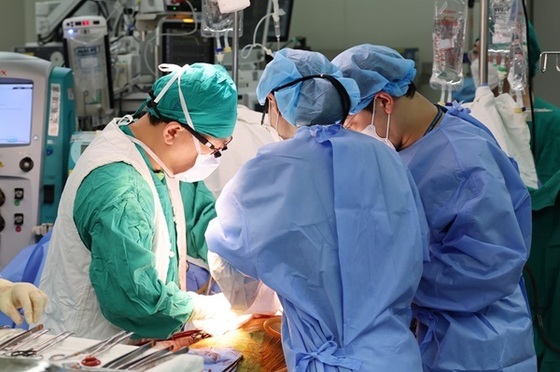
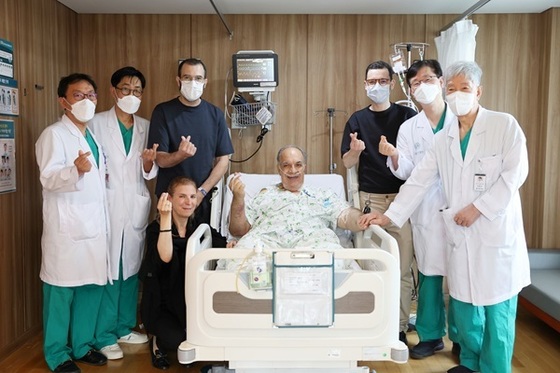
A man in his 60s with end-stage liver failure, advanced liver cancer and severe obesity weighing 135 kilograms had been told by even France’s top medical specialists that surgery was no longer possible. He traveled that immense distance to Korea. After a grueling 17-hour operation, he survived after receiving liver grafts from each of his two sons.
The patient, 64-year-old Mohamed El Ketani, began his battle with illness 20 years ago with hepatitis C. With 85% of his liver damaged, doctors recently discovered a 6-centimeter tumor, with the cancer cells also invading the main portal vein. Even France’s leading liver transplant centers had given up on performing a transplant.
In desperation, the brothers, including the second son who is a cardiac surgeon, scoured medical literature from around the world and found a hospital. It had performed more than 9,000 liver transplants, the first single hospital to reach that milestone; conducts about 400 living-donor liver transplants annually; has performed a world-leading 664 two-donor-to-one-recipient living-donor liver transplants; and has recorded zero deaths among living liver donors. It was the Asan Liver Transplantation Center at Asan Medical Center in Seoul, a destination for patients from around the world who cross borders in search of a last hope.
How did Asan Medical Center prove the “miracle of life” to a patient who had flown 10,000 kilometers based solely on its research and surgical outcomes? We spoke with Moon Deok-bok, a professor of liver transplantation and hepatobiliary surgery who led the complex operation, about what happened behind the scenes during the 17-hour surgery, the precision involved in two-donor-to-one-recipient living-donor liver transplantation, and the future of Korean liver transplantation.
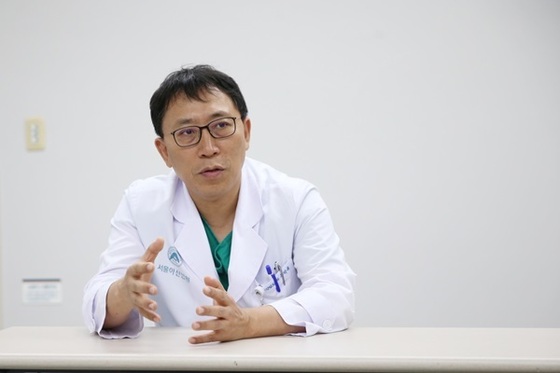
-You gave a new lease on life to a Moroccan patient whose treatment had been deemed impossible by medical teams overseas.
▶France is considered one of the world’s advanced medical systems, along with the United States, Germany and Japan. Yet this patient was in a condition for which it was difficult to find a treatment option in those countries.
After coming to the liver transplant team at Asan Medical Center, he underwent appropriate downstaging treatment for hepatocellular carcinoma before the transplant. This allowed us to minimize the risk of cancer recurrence after transplantation.
We also performed a two-donor-to-one-recipient living-donor liver transplant. When the weight of the liver graft from a single donor is insufficient, there is a risk of graft dysfunction after transplantation. By using two donors, we were able to secure a sufficient amount of liver tissue and eliminate that risk.
-What was the most difficult part of the surgery?
▶Because this was a two-donor-to-one-recipient living-donor liver transplant, we first had to remove the upper portion of the main portal vein, where cancer invasion was suspected, and then reconstruct the left and right portal veins so that blood flow could be supplied to the two liver grafts. We successfully performed the highly complex vascular reconstruction using blood vessels from a deceased donor, which made the two-donor-to-one-recipient transplant possible.
However, when we perfused the two liver grafts with blood, we found that the space previously occupied by the patient’s liver was much smaller than expected. As a result, the transplanted right liver shifted toward the left, compromising venous drainage from the right graft. We therefore performed an additional procedure to separate the right adrenal gland and kidney from the retroperitoneum and reposition them toward the front of the abdominal cavity. This created enough space for the right liver graft to settle securely and restored normal venous drainage. Ultimately, we were able to complete the surgery successfully.
-What type of patients require the two-donor-to-one-recipient living-donor liver transplant used in this case?
▶For a successful liver transplant, the recipient generally needs to receive a liver graft weighing at least 0.8% to 1% of their body weight. This is necessary to provide enough liver function for recovery after transplantation. If the graft is too small, the metabolic processes needed for recovery cannot function properly, potentially leading to graft dysfunction.
However, there are cases in which the liver graft that a single donor can provide does not meet this requirement. In such cases, an additional graft from a second donor can be transplanted to secure the necessary liver volume. This is known as a two-donor-to-one-recipient living-donor liver transplant.
Because two liver grafts must be transplanted into a single recipient, the procedure is highly complex. In reality, it is difficult to find a center other than Asan Medical Center that can routinely perform this surgery, which requires close collaboration among multiple liver transplant surgeons.
-What do you consider the decisive turning point in Asan Medical Center’s development into a world-class liver transplant center?
▶When living-donor liver transplantation was first introduced in South Korea, we lagged behind countries such as Japan and Hong Kong, which were leaders in liver transplantation. But there was a major change when Professor Lee Seung-gyu, a distinguished professor of liver transplantation and hepatobiliary surgery, developed a modified right-lobe liver transplant technique.
In conventional right-lobe liver transplantation, congestion throughout the right-lobe graft could lead to graft dysfunction. The new technique dramatically reduced that problem, and Asan Medical Center’s outcomes after living-donor liver transplantation improved to the highest level in the world. I believe this was the most important turning point.
Another was the development and establishment of the technically demanding two-donor-to-one-recipient living-donor liver transplant. It not only demonstrated our technical expertise to the world but also opened the possibility of transplantation for patients who could not receive a graft because of the size ratio between the donor’s left and right liver, as well as patients whose large body size meant a single donor could not provide a sufficient liver graft.
-How far have the safety and success rates of living-donor liver transplantation advanced?
▶For conventional living-donor liver transplantation, I believe the safety and success rates are above 95% to 97%. However, the complexity of liver transplantation varies significantly depending on the recipient’s overall condition at the time of transplantation, previous surgeries and treatments, and the condition of the blood vessels and bile ducts. Donors can also have different graft recovery outcomes depending on how much liver tissue they can provide relative to the recipient’s body weight.
-What technology are you most excited about in the field of liver transplantation over the next 10 years?
▶Laparoscopic surgery is now performed safely in most living liver donors. Robotic surgery for donors has also recently been introduced. As experience accumulates, I believe it could become a safe and widely used surgical method, just as laparoscopic surgery did.
For recipients, however, it remains to be seen whether the benefits of minimally invasive surgery will outweigh those of conventional open surgery.
-What does Asan Medical Center focus on most to ensure donor safety?
▶The most important consideration in living-donor liver transplantation is donor safety. Asan Medical Center has performed surgery on more than 8,500 living liver donors to date, with a procedure-related mortality rate of 0%.
In recent years, living liver donors have tended to be older than in the past, meaning the surgical risks for donors could potentially increase. When we determine that the risks may be higher, we actively recommend a two-donor-to-one-recipient living-donor liver transplant to reduce the burden and risk to each donor.
-Is there anything else you would like to say?
▶I learned a great deal from senior physicians, including Professor Lee Seung-gyu, and became the liver transplant and hepatobiliary surgeon I am today. But I have only six years left until retirement.
Looking at the current state of medicine in South Korea, people are avoiding surgery for various reasons, and highly demanding fields such as hepatobiliary and liver transplantation are being avoided even more. Given this situation, I cannot help but wonder whether South Korea will be able to maintain its current level of medical care 10 or 20 years from now. Considering the future of Korean medicine, I believe the government and the country as a whole need to take active measures and make a concerted effort.