mRNA acts as a blueprint instructing our cells to produce essential proteins. While it gained prominence through COVID-19 vaccines, it has a significant limitation: rapid degradation once inside cells, resulting in a short lifespan.
Viruses, however, have long overcome this challenge. They’ve evolved various survival strategies to protect their RNA from quick degradation within host cells.
A team of researchers analyzed roughly 200,000 RNA samples from 337 virus types, uncovering new regulatory elements that extend mRNA longevity. When applied to linear mRNA, these elements tripled its half-life from 7.6 to 23.1 hours. This breakthrough could potentially enhance the efficacy of mRNA vaccines and treatments for cancer and rare diseases.
On Friday, the Ministry of Science and Information and Communications Technology (ICT) announced that a research team led by Dr. Kim V. Narry, director of the RNA Research Center at the Institute for Basic Science (IBS), conducted an extensive analysis of RNA regulatory strategies in vertebrate-infecting viruses. Their study, published in the prestigious journal Cell, revealed principles that boost RNA stability and protein production.
The Viral Strategy: Protecting mRNA with a Tail
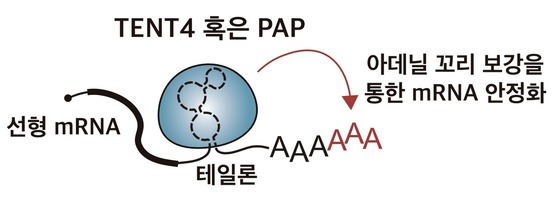
mRNA molecules end with a long ‘poly(A) tail’ composed of adenine nucleotides. This tail acts as a shield, preventing easy degradation of the mRNA. As the tail shortens over time, the mRNA becomes unstable and eventually disappears.
Viruses face a similar challenge in host cells. If their RNA degrades too quickly, they can’t produce enough essential proteins. Some viruses have evolved strategies to protect their mRNA’s tail, a method the research team explored for potential therapeutic applications.
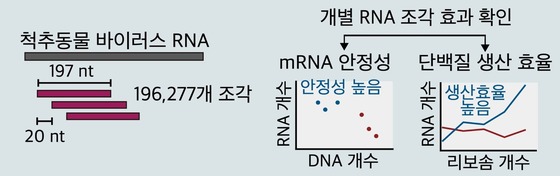
The scientists fragmented the genomes of 337 virus types into roughly 200-base-long segments, creating about 200,000 RNA fragments. They then compared how each fragment impacted mRNA stability and protein production.
A standout discovery was Pt1. This element attracts an enzyme called PAP, which produces the poly(A) tail, effectively replenishing the protective tail as it wears down.
The team dubbed this viral regulatory element that enhances RNA tail stability tailon.
Tripling Half-life, Quintupling Protein Production: Therapeutic Potential
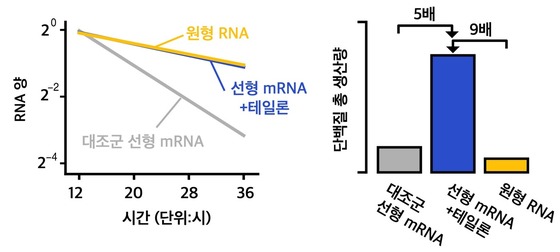
Attaching Pt1 to linear mRNA increased the number of adenines in the poly(A) tail from 60 to 194. This extension tripled the mRNA’s half-life from 7.6 to 23.1 hours, reaching stability levels comparable to circular RNA, known for its durability.
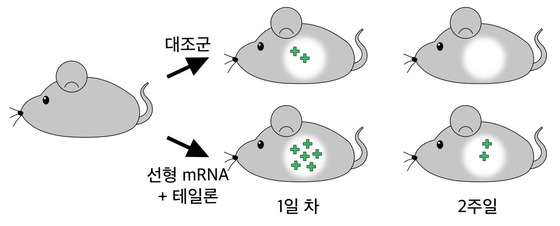
The increased longevity led to a surge in protein production. Tailon-enhanced linear mRNA produced about five times more protein than standard linear mRNA. In mouse studies, protein production signals persisted for two weeks post-administration, while the control group’s signals vanished within a day.
The researchers confirmed tailon’s effectiveness in therapeutic mRNA containing modified nucleotides used in COVID-19 vaccines. This technology could potentially extend the duration of protein production in mRNA vaccines and treatments.
However, it’s crucial to note that tripling mRNA’s half-life doesn’t necessarily mean the treatment’s efficacy will last three times longer. The team plans further studies to validate tailon’s impact on actual mRNA therapeutics and explore its application in treatments for rare diseases and cancer.