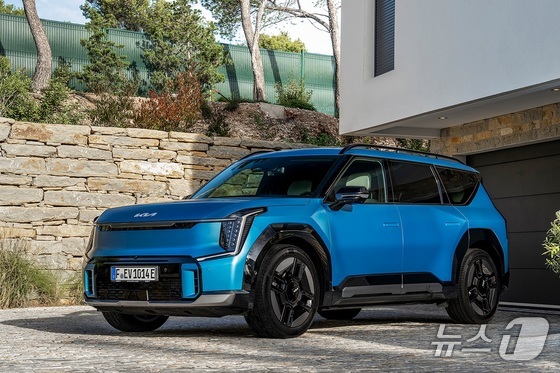
Kia’s EV9 has surpassed Volvo’s EX90, claiming the best large electric sport utility vehicle (SUV) title. This achievement is attributed to its superior interior space, acceleration performance, energy efficiency, and pricing compared to competing models.
According to Kia, the German automotive publication Auto Bild recently awarded the EV9 a higher score in a comparative evaluation against the EX90 on Wednesday.
This comparison holds significant weight as it pits the 2024 World Car of the Year (EV9) against the 2025 World Luxury Car (EX90), marking a notable face-off between large electric SUVs. The World Car of the Year (WCOTY) is determined annually by automotive journalists worldwide. Over the past two years, only these two models have received awards in the large electric SUV category.
The evaluation focused on seven categories: body, convenience, powertrain, driving performance, connectivity, eco-friendliness, and economy. It compared the EV9 GT-Line (all-wheel drive (AWD)) with the EX90 Twin Motor AWD. The EV9 excelled in body, powertrain, and economy categories while matching the EX90 in other areas, scoring 589 points to the EX90’s 571.
In the body category, the EV9 impressed with its spacious interior. It features a long 3100mm (approximately 122 in.) wheelbase, independent second-row seats, and a maximum cargo capacity of 2393L (approximately 84.5 cu ft) with the second row folded. These attributes align well with the practical and design standards demanded by the European market.
The EV9 also outperformed or matched the EX90 in the powertrain category, demonstrating superior overall driving quality, responsiveness, top speed, and energy efficiency. Auto Bild‘s tests revealed that the EV9 achieved a 0-100 km/h (approximately 0-62 mph) time of 5.2 seconds and a passing acceleration from 80 to 120 km/h (approximately 50 to 75 mph) in 3.5 seconds, besting the EX90’s times of 5.8 and 3.7 seconds, respectively.
Manufacturer specifications indicate that the EV9 GT-Line produces 385 horsepower (283 kW), while the EX90 Twin Motor AWD boasts 408 horsepower (300 kW). Auto Bild noted that despite the power difference, the EV9’s victory can be attributed to its approximately 120 kg (approximately 264.6 lbs) lighter weight and more efficient electric powertrain.
The EV9 demonstrated superior energy efficiency in real-world testing, showcasing its impressive battery management system (BMS). During a challenging 155 km (approximately 96.3 miles) test drive, the EV9 achieved an energy consumption rate of 27.9 kWh/100 km (approximately 27.9 kWh/62.1 miles), about 20% better than the EX90’s 33.5 kWh/100 km (approximately 33.5 kWh/62.1 miles). Auto Bild praised the EV9’s battery management system as significantly more efficient.
Moreover, the EV9’s 800V architecture supports a maximum charging speed of 210 kW, allowing it to charge from 10% to 80% in about 24 minutes. Despite the EX90’s higher 250 kW charging capability, it takes 32 minutes to charge the same capacity, 8 minutes longer than the EV9.
In driving performance, the EX90, despite its air suspension, exhibited oversteer during high-speed cornering. The EV9, conversely, earned praise for its stable handling and performance limits, thanks to its well-tuned chassis that effectively managed road changes and corners.
The EV9 clearly demonstrated a competitive advantage in the economy category. Auto Bild highlighted that the EV9 offers performance comparable to the EX90 at a much more reasonable price, noting the nearly 28,000 EUR (approximately 31,300 USD) price difference between the two models.
A Kia representative expressed pride in the Auto Bild evaluation, stating that this recognition reaffirms the electric vehicle (EV) technology built on Hyundai Motor Group’s dedicated electric global modular (E-GMP) platform and the value of the EV9. Further, it will continue to provide high value to our customers through a diverse lineup of EVs.