The global electric vehicle (EV) (battery EV + plug-in hybrid EV (BEV+PHEV)) market showed signs of deceleration at the beginning of this year. While worldwide EV sales experienced a slight decline in January, there were stark regional differences. China and North America saw significant contractions, whereas Europe maintained double-digit growth.
Sales figures for most major global brands also decreased. However, Hyundai Motor Group bucked this trend, achieving stable growth through its market diversification strategy.
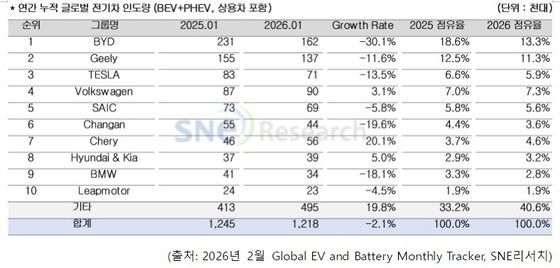
Market research firm SNE Research reports that the total number of electric vehicles registered worldwide in January was 1.218 million, down 2.1% compared to the same period last year. The global EV market had been growing at an impressive average annual rate of 34.9% since 2017, but this year has shown signs of a slowdown right from the start.
Major electric vehicle manufacturers also experienced declining sales. BYD retained its top position despite a 30.1% decrease, selling 162,000 EVs. Geely Group came in second with 137,000 EVs sold, an 11.6% decline.
Analysts attribute the sales decline for these two leading Chinese electric vehicle brands to a combination of seasonal market downturns, inventory adjustments, and intensified price competition in the domestic market.
Volkswagen ranked third, selling 71,000 vehicles, marking a 3.1% increase from the previous year. Tesla, in fourth place, sold 71,000 vehicles, reflecting a 13.5% decrease compared to the same month last year. Notably, Tesla’s sales in China plummeted by 45.2% due to aggressive pricing strategies from local brands. However, the company saw modest increases of 2.9% and 3.6% in North America and Europe, respectively, thanks to strategic pricing adjustments and the introduction of standard trims.
Shanghai Automotive Industry Corporation (SAIC) ranked fifth, selling 69,000 vehicles, down 5.8% from the previous year.
Hyundai Motor Group continued to demonstrate relatively stable growth in the global market, selling 39,000 vehicles, a 5% increase. This success is attributed to the effectiveness of their market diversification strategy. While they experienced a 38.1% drop in the North American market due to short-term demand adjustments, they recorded a solid 7.3% increase in Europe. In Asia (excluding China), they saw a remarkable increase of 234.4%.
Regional market trends showed significant disparities. Sales in China fell by 16.4%, totaling 646,000 vehicles, while North America saw a 30.2% decline, with only 86,000 vehicles sold. In contrast, Europe maintained its growth trajectory with a 19.5% increase, reaching 307,000 vehicles, and the Asian market (excluding China) recorded an impressive 96.5% increase, totaling 138,000 vehicles.
Analysts suggest that the Chinese market is transitioning from an early high-growth phase to a maturity stage as electric vehicle adoption rates rise rapidly. In North America, demand is quickly declining due to increased price pressures following the expiration of federal EV tax credits last year.
Europe, on the other hand, continues to experience structural transitions toward electrification, despite discussions about reducing subsidies and adjusting policies. This is largely due to the maintenance of carbon emission regulations and average emissions management policies for manufacturers. The Asian market also shows sustained growth, with a shift in policy direction from subsidy-based approaches to incentives tied to local production and supply chain connections.
SNE Research concludes that while the global EV market remains on a long-term expansion path, it is gradually moving away from the policy-driven high-growth phase seen in the past. They predict that future competition will hinge not merely on expanding sales volumes but also on factors such as adaptability to policy changes, stability of local production and supply chains, securing price competitiveness, and strategies for powertrain mix.