New research suggests that adopting more healthy lifestyle habits can significantly reduce your risk of developing metabolic dysfunction-associated fatty liver disease.
The National Institute of Health under the Korea Disease Control and Prevention Agency announced on Tuesday that, based on an analysis of data from the Korea National Health and Nutrition Examination Survey conducted from 2016 to 2021, healthy lifestyle habits are associated with a reduced risk of metabolic fatty liver disease.
Metabolic fatty liver disease is a chronic liver condition characterized by the accumulation of fat in the liver and is associated with cardiometabolic risk factors such as obesity and diabetes.
Formerly known as non-alcoholic fatty liver disease, it can progress to cirrhosis and is also linked to cardiovascular disease, necessitating consistent management.
The prevalence of metabolic fatty liver disease among adults in Korea is 24.1%, meaning approximately one in every four adults is affected.
While previous studies primarily analyzed the association between individual lifestyle factors and fatty liver disease, there was insufficient evidence regarding the association between combinations of multiple healthy lifestyle factors and metabolic fatty liver disease.
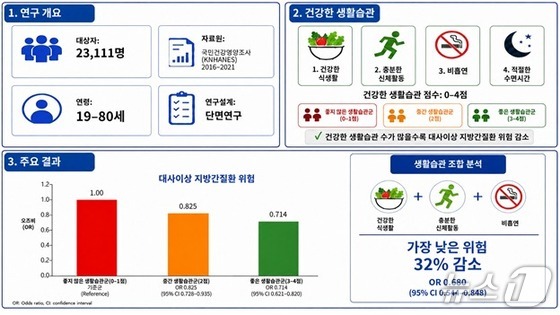
Therefore, the research team analyzed the association between four healthy lifestyle habits—a healthy diet, sufficient physical activity, not smoking, and adequate sleep—and the condition using data from 23,111 adults aged 19 to 80 who participated in the Korea National Health and Nutrition Examination Survey.
The analysis revealed that the more healthy lifestyle habits participants practiced, the lower their likelihood of having metabolic syndrome-associated fatty liver disease.
Compared to the group that practiced 0–1 healthy habit, the risk was 17.5% lower in the group practicing 2 habits and 28.6% lower in the group practicing 3–4 habits.
In particular, when lifestyle factors were analyzed in combination, the risk of metabolic dysfunction-associated fatty liver disease was reduced by approximately 32% when a healthy diet, sufficient physical activity, and non-smoking were practiced together, showing the most pronounced reduction.
This finding is significant in that it confirms the impact of combined healthy lifestyle habits—rather than a single lifestyle habit—on liver health.
The research team stated that managing lifestyle habits is important. This study is significant because it confirmed the association between healthy lifestyle habits and metabolic syndrome-associated fatty liver disease using data from the Korea National Health and Nutrition Examination Survey, which represents the adult population in Korea.
Meanwhile, the results of this study were recently published in the international academic journal BMC Public Health.