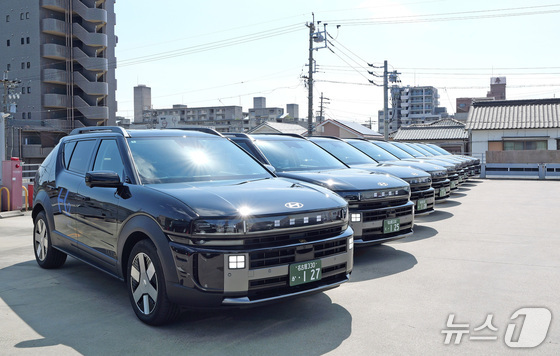
Hyundai Motor Company announced on Thursday that its hydrogen fuel cell vehicle, the All-New NEXO, has captured approximately 11% of the passenger hydrogen fuel cell vehicle market in Japan. This milestone was achieved just five months after its April launch.
According to the Japan Automobile Dealers Association, Hyundai’s cumulative market share in Japan’s passenger hydrogen fuel cell vehicle sector from April to August 2026 stands at around 11%.
During this period, 20 units of the All-New NEXO were sold, with the number increasing to 35 when including vehicles awaiting customer delivery. Notably, 22 of these units are slated for taxi operators in Tokyo and Aichi, key hubs in the local automotive market.
The Japanese taxi market has long been a stronghold for domestic manufacturers, presenting significant challenges for imported brands. Hyundai is targeting this market by highlighting the All-New NEXO’s enhanced durability, extended range, and spacious interior.
The All-New NEXO’s fuel cell system boasts an 11% improvement in rated output, now reaching 94 kW. Hyundai has implemented advanced technologies to prevent electrolyte membrane damage and reinforced stack designs, significantly enhancing durability.
The high-voltage battery output has doubled from 40 kW to 80 kW, addressing the rapid charging and discharging cycles typical of hydrogen fuel cell vehicles. Hyundai has rigorously tested the fuel cell system’s durability under harsh conditions mimicking real-world scenarios, including urban congestion and prolonged idling.
Range is a key selling point for the All-New NEXO. It can travel up to 720 km (about 447 miles) on a single charge, with Japan’s WLTC certification standards indicating a potential range of 1,014 km (about 630 miles). This impressive efficiency is expected to appeal to the Japanese taxi industry, where annual mileage typically ranges from 50,000 to 100,000 km (about 31,070 to 62,140 miles).
Interior improvements include a more spacious second row and a 510-liter trunk, accommodating large luggage and golf bags with ease. The Japanese model comes standard with a Vehicle-to-Home (V2H) feature, allowing the vehicle to power homes or appliances during emergencies or outages.
Japan’s government and local authorities’ push for hydrogen mobility is bolstering Hyundai’s market strategy. The government has prioritized hydrogen adoption for commercial vehicles like taxis, buses, and trucks, offering purchase subsidies and other incentives.
Tokyo aims to deploy 600 hydrogen fuel cell taxis by 2030 and 10,000 commercial hydrogen fuel cell vehicles by 2035, offering substantial subsidies. The city also provides up to 1.3 million JPY (about 8,200 USD) annually to offset the cost difference between hydrogen and LPG refueling.
Aichi Prefecture has set a target of introducing 250 hydrogen fuel cell taxis by 2030, offering 3.5 million JPY (about 22,120 USD) in purchase subsidies per vehicle and 576 JPY (about 3.84 USD) per kilogram in hydrogen fuel cost support.
A Hyundai spokesperson noted that the Japanese taxi industry, known for its focus on durability and convenience, is showing keen interest in the All-New NEXO. It believes the introduction of NEXO taxis will improve perceptions of imported cars and hydrogen fuel cell vehicles, leading to positive market reception.
In related news, Hyundai launched the 2027 NEXO, an updated version of the All-New NEXO, in its domestic market last July. This refresh enhances the entry-level trim’s features and expands the range of optional equipment.