

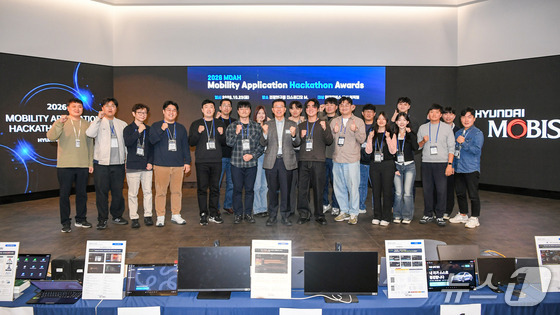
Hyundai Mobis is leveraging its employees’ creative ideas to bolster its vehicle software (SW) competitiveness. The company is supporting all employees, regardless of their job function, in developing vehicle applications using artificial intelligence (AI) technology. This strategy aims to transform outstanding ideas into actual services, positioning Hyundai Mobis to thrive in the era of software-defined vehicles (SDVs).
Hyundai Mobis announced on Wednesday that it hosted the 2026 Mobility Application Hackathon for its employees. The event focused on developing infotainment apps centered around SDVs and AI, with participation open to all Hyundai Mobis staff, irrespective of their roles.
This year’s event saw 67 teams participate, developing apps over a five-week period spanning preliminary and final rounds that began in September. The ten finalist teams presented their development concepts in person.
The grand prize went to MOBIDIC, an AI-powered vehicle diagnostic app. Other standout entries included MobiMon, which presents vehicle information through animated characters, and Car de Maker, an AI-driven app that transforms driving records into collectible digital cards.
To facilitate the transition of these apps from concept to actual services, Hyundai Mobis provided participants with various software development environments. These included InfoLINK, an infotainment-specific development platform; IDELINK, a web-based cloud development system; and a vehicle on-device AI software development kit (SDK).
InfoLINK, developed in-house by Hyundai Mobis, is tailored for the Android Automotive Operating System (AAOS). It integrates vehicle information with apps to control various functions and allows passengers to easily update programs through an app marketplace.
IDELINK, another proprietary cloud-based development environment from Hyundai Mobis, enables developers to write and validate code from any location with internet access.
The on-device AI SDK is a cutting-edge tool that implements AI functions within the vehicle, eliminating the need for external servers. It supports interactive AI, recognizing voice commands, hand gestures, facial expressions, and eye movements of both drivers and passengers. This approach reduces dependence on network connectivity and enhances personal data protection.
Hyundai Mobis is evaluating the feasibility of employee-proposed ideas, potentially converting them into development projects. The company is also assessing their commercial viability through competitions. Additionally, Hyundai Mobis is investing in future mobility technologies, such as advanced vehicle electronic control systems, to strengthen its position in electronic components and software.
Beyond the employee hackathon, Hyundai Mobis runs the Mobius Boot Camp to cultivate vehicle software talent. This initiative offers specialized software training to job seekers and employees of partner companies, bridging the gap between young talent and companies seeking skilled professionals.
In its latest financial report, Hyundai Mobis announced preliminary second-quarter results with sales of 16.3247 trillion KRW (approximately 12.2 billion USD), operating profit of 975.2 billion KRW (about 730 million USD), and net profit of 1.0602 trillion KRW (about 793 million USD). The quarterly revenue set a new company record, exceeding 16 trillion KRW (about 12 billion USD) for the first time. The operating profit also reached an all-time high for a second quarter.