
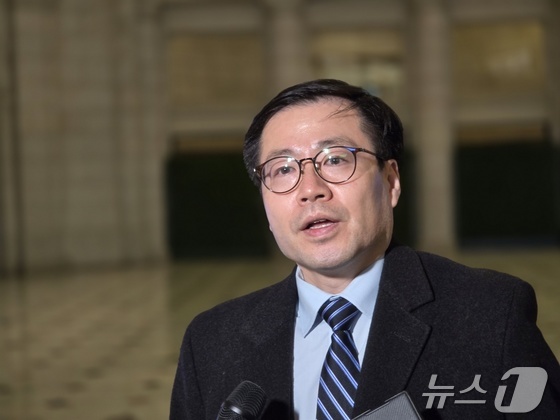
On Wednesday, Yeo Han Koo, the head of the Trade Bureau at South Korea’s Ministry of Trade, Industry and Energy, announced that he had postponed his return to South Korea. This decision was made to assess the potential impact on South Korea after President Donald Trump signed a proclamation imposing a 25% tariff on AI semiconductor chips from companies like NVIDIA.
Speaking to South Korean correspondents at Union Station in Washington, D.C., Yeo said that after meetings earlier in the day, he learned of new announcements related to semiconductors and critical minerals. He added that although he had planned to fly back that evening, he decided to stay an additional day to gather more information.
The proclamation signed by President Trump imposes a 25% tariff on specific high-performance computing semiconductors, including NVIDIA’s H200 and AMD’s MI325X.
The U.S. administration set this tariff as a condition for allowing NVIDIA to sell AI semiconductors, such as the H200 produced through Taiwan’s TSMC, to China.
While the H200 chip is an older model that Trump previously allowed to be exported to China with a 25% sales revenue tax, it still outperforms the existing H20 chips designed exclusively for Chinese export. However, it doesn’t match the capabilities of the latest Blackwell products.
As a result, chips produced in Taiwan will be subject to a 25% tariff when routed through the U.S. to final destinations, including China. Typically, tariffs are imposed on goods imported into the U.S., so H200 chips exported to any country, not just China, may be affected by this 25% tariff.
On Tuesday, a day before the tariff announcement, the Department of Commerce published a notice in the Federal Register easing the criteria for permits to export H200 semiconductors to China, completing the preliminary steps.
Consequently, starting at 12:01 AM on Thursday, tariffs will apply to items imported or exported for consumption.
Regarding the potential impact on South Korea’s industry, Yeo said the situation is still being closely monitored and that it is premature to make definitive statements. He added that officials are working with headquarters and industry partners to analyze the implications.
Yeo, who arrived in the U.S. on Sunday, had originally planned to travel from Washington, D.C. to New York and then fly back to South Korea that night.
Reflecting on his U.S. visit, Yeo noted that it marked the first high-level meeting since the two countries agreed on tariff negotiations. He said the delegation held extensive discussions with the U.S. government, Congress, and industry, adding that he confirmed there are high expectations for cooperation in South Korea’s manufacturing and investment sectors.
He emphasized the need for careful responses to South Korea’s digital regulatory legislation and the potential impact of the U.S. Supreme Court’s ruling on mutual tariffs imposed under the International Emergency Economic Powers Act (IEEPA).
Yeo said that a high-ranking South Korean government official had come to the U.S. to explain the country’s digital legislation directly to the U.S. Congress and industry, adding that he believes this helped improve communication and understanding.
When asked about predictions for the Supreme Court’s tariff ruling, Yeo said that after meeting with many experts, it appears a decision could come at any time, with opinions evenly divided, making it difficult to make a definitive forecast.
He stressed that the Trump administration is determined to maintain its current tariff policy regardless of the outcome, adding that preparations are underway for all possibilities, including potential refunds related to the Supreme Court ruling.
Yeo added that expert opinions remain divided, with some predicting an invalidity ruling and others believing it is unlikely the court would rule against the government, noting that responses are being prepared for all scenarios.
He mentioned that if the Supreme Court rules against the tariffs, the Trump administration might consider various legal measures, including Sections 301, 122, and 339 of the Trade Act, to maintain its tariff policy.
Regarding the Coupang situation, in which some U.S. officials perceive unfair discrimination against American companies, Yeo clarified that the core issue is a massive data leak that led to personal privacy violations, and that this warrants investigation by both countries. He stressed that the matter should not escalate into a trade or diplomatic dispute.
Responding to U.S. House members who likened their support for Coupang to a witch hunt, Yeo said witnesses were contacted in advance to explain the South Korean government’s objective stance. However, he noted they appeared to have their own agendas.
He shared that he met with Adrian Smith, the chair of the subcommittee that held the hearing, who expressed significant concern. Yeo said he explained why the South Korean government had to respond as it did, noting that a data breach affecting 33.7 million people in the United States would naturally prompt investigations and concern, and that Smith understood this perspective.
After completing his U.S. visit, Yeo will depart for Switzerland to attend the World Economic Forum in Davos from January 19 to 26.


