The White House and government are closely monitoring the Trump administration’s semiconductor-related proclamation. With the U.S. threatening high tariffs on memory chips, a key product for South Korean companies, officials are carefully crafting negotiation strategies, using Taiwan’s case as a benchmark.
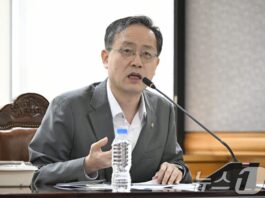
On Sunday, the Blue House sources revealed that Policy Chief Kim Yong Beom will discuss countermeasures after receiving a briefing from the Ministry of Trade, Industry, and Energy on U.S. semiconductor tariff measures.
Earlier, Trade Negotiation Chief Yeo Han Goo visited the U.S. on January 11 to discuss non-tariff barriers as a follow-up to the U.S.-Korea trade fact sheet. He extended his stay when the U.S. announced its semiconductor proclamation, focusing on assessing the situation before returning on Saturday.
The Trump administration’s proclamation, based on Section 232 of the Trade Expansion Act, imposes a 25% tariff on select advanced computing chips, including NVIDIA’s H200 and AMD’s MI325X.
However, with the U.S. signaling potential expansion of these measures, South Korean memory chip giants Samsung Electronics and SK Hynix could be affected. U.S. Commerce Secretary Gina Raimondo stated on Friday that memory chip producers face two choices: pay a 100% tariff or manufacture in the U.S.
While Raimondo didn’t name specific countries or companies, analysts interpret her comments as pressure on Samsung and SK hynix, given their dominance in the global memory chip market.
A senior Blue House official noted, “While the current tariffs are limited and don’t explicitly target memory chips, we’re analyzing the situation closely, anticipating a second phase of measures.”
During last year’s trade talks with the U.S., South Korea only secured a general agreement on non-discriminatory treatment for semiconductor tariffs. If the U.S. extends high tariffs to memory chips, further negotiations will be necessary.
South Korean officials are studying the U.S.-Taiwan trade agreement. Taiwan previously secured conditional tariff exemptions in exchange for $250 billion in U.S. investments from companies like TSMC.
The agreement allows Taiwanese firms building new U.S. facilities to import 2.5 times their planned production capacity tariff-free during construction, with preferential rates on excess imports. Completed facilities can import up to 1.5 times their new capacity tariff-free.
It’s unclear if the U.S. will offer similar terms to South Korea. Samsung is investing $37 billion in a Texas foundry, while SK hynix plans a $3.87 billion advanced packaging facility for AI memory in Indiana.
Concerns arise that, even with similar terms, South Korean firms might be at a disadvantage due to smaller investments and production capacities compared to Taiwan’s TSMC.
A Blue House official stated that the government is analyzing how the U.S.-Taiwan agreement could affect South Korea’s tariff conditions and will discuss follow-up preparations after consultations with relevant ministries.
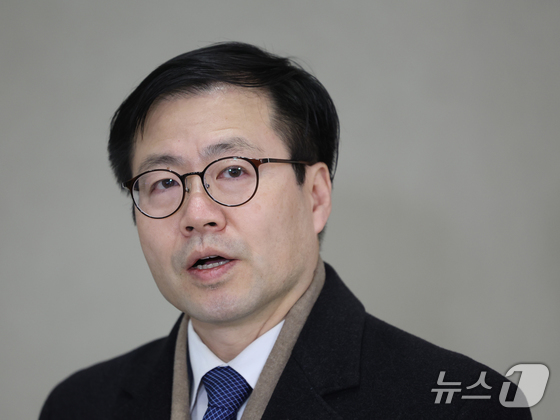
Trade Chief Yeo told reporters at Incheon Airport that South Korea and the United States agreed last year on non-discriminatory treatment in the semiconductor sector, adding that further discussions are needed in light of the recent U.S.-Taiwan agreement.
The Blue House emphasized that it’s premature to predict impacts, as formal Section 232 measures haven’t been announced and details of the Taiwan agreement remain vague. They plan to proceed with negotiations calmly, aiming for conditions no less favorable than Taiwan’s, as outlined in the joint fact sheet.