Extreme fluctuations in U.S.-South Korea relations marked U.S. President Donald Trump’s first year of his second term. The December 3 state of emergency eroded trust between the two nations, sparking fears that South Korea might be sidelined in peninsula diplomacy as Trump eagerly pursued talks with North Korea. Moreover, South Korea faced unprecedented pressure in trade and security due to Trump’s America First policy.
However, President Lee Jae Myung, who took office last June, swiftly restored communication between the two leaders by holding two summits with Trump in just six months. These meetings yielded tangible results, including agreements on South Korea’s nuclear submarine program and revisions to the U.S.-South Korea nuclear cooperation agreement.
Even before his official inauguration, Trump expressed a keen interest in dialogue with North Korea. At a press conference shortly after taking office on January 20 last year, he boasted of his close relationship with North Korean leader Kim Jong Un. He referred to North Korea as a nuclear power, which some interpreted as Trump officially acknowledging North Korea’s nuclear status.
Trump’s re-emergence, while South Korea was still grappling with the aftermath of the December 3 state of emergency, posed a significant challenge for Korean diplomacy. If North Korea responded quickly to Trump’s overtures, it would be difficult for the incoming administration, which needed 5 more months to take office, to engage in U.S.-North Korea talks. Compounding the issue, the Yoon Suk Yeol administration’s failure to communicate diplomatically during the state of emergency declaration had severely damaged U.S. trust in South Korea.
Trump also pursued the implementation of substantial global tariffs, regardless of alliance status. South Korea found itself subject to a 25% mutual tariff. The Lee Jae Myung administration, which championed practical diplomacy, thus faced an enormous diplomatic challenge from the outset.
After intense negotiations, the U.S. and South Korea reached a sudden agreement to lower mutual tariffs to 15%. In exchange, South Korea accepted a $350 billion investment commitment to the U.S. Additionally, as the U.S. sought fundamental changes to its security structure, South Korea faced unprecedented negotiations in both trade and security.
Trump’s second-term administration is pursuing alliance modernization, arguing that countries should take greater initiative in addressing their own security issues. For South Korea, this means a shift in the role of U.S. forces from deterring North Korea to countering China.
To accommodate this change, South Korea agreed to increase its defense spending to 3.5% of GDP and boost purchases of American weapons. In return, the U.S. approved South Korea’s acquisition of nuclear submarines. It agreed to accelerate the transfer of wartime operational control, opening avenues for South Korea to take the lead in addressing its security concerns.
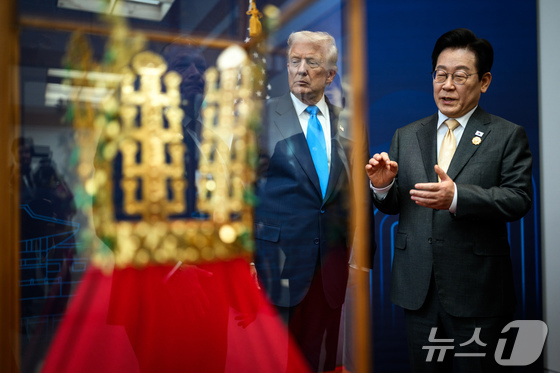
The initially unstable U.S.-South Korea relationship quickly regained its footing after the inauguration of South Korea’s new government, with diplomatic channels and leader-to-leader communication swiftly restored.
The tariff and security issues were resolved during the U.S.-South Korea summit held on the sidelines of the Asia-Pacific Economic Cooperation (APEC) meeting in Gyeongju in late October. Notably, agreements on the long-sought nuclear submarine program and revisions to the U.S.-South Korea nuclear cooperation agreement were highlighted as significant achievements. These leader-level agreements were documented in a joint fact sheet, serving as a form of guarantee.
The current U.S.-South Korea nuclear cooperation agreement requires case-by-case U.S. approval for South Korea’s uranium enrichment and spent nuclear fuel reprocessing. The government is exploring a comprehensive pre-approval mechanism for these activities within a specified timeframe. To this end, it has established a government-wide task force and is preparing for in-depth discussions with the U.S.
Furthermore, South Korea is poised to begin substantial negotiations with the U.S. to establish separate agreements for constructing nuclear submarines domestically and importing nuclear fuel from the U.S.
While U.S.-South Korea relations have experienced extreme swings, they are likely to enjoy a period of warmth for the foreseeable future. However, given Trump’s transactional approach that often deviates from traditional values, it remains uncertain when high-pressure tactics might resurface.
The South Korean government plans to create a diplomatic environment conducive to U.S.-North Korean contacts during Trump’s April visit to China. This strategy appears aimed at focusing Trump’s attention on North Korean issues.