

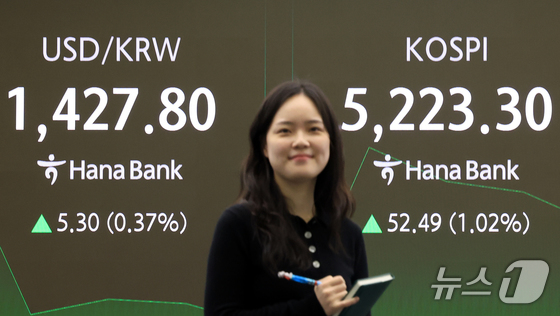
The Federal Reserve (Fed) kept its benchmark interest rate unchanged at its first Federal Open Market Committee (FOMC) meeting of the year. This pause was widely anticipated, and experts predict it will have minimal impact on the Bank of Korea’s monetary policy or the dollar-won exchange rate.
However, financial markets are more focused on who will be nominated as the next Fed chair than on the rate decision itself. Rick Rieder, BlackRock’s Global Fixed Income Chief Investment Officer (CIO), is a leading candidate known for his dovish stance. His potential appointment could lead to a weaker dollar and a possible decline in the dollar-won exchange rate.
The Fed concluded its January FOMC meeting on Thursday, maintaining the benchmark rate at 3.50% to 3.75%. Chair Jerome Powell cited the surprisingly strong U.S. economy as the reason for holding rates steady, suggesting the Fed wants to evaluate the effects of its three consecutive rate cuts in late 2023.
This decision was expected, resulting in limited market volatility following the announcement. However, investors are eagerly awaiting news on the post-Powell era, as President Trump is expected to nominate the next chair before Powell’s term ends in May.
The Fed expressed strong confidence in the U.S. economy despite keeping rates unchanged. Notably, it upgraded its assessment of economic activity from moderate to solid in its policy statement.
Worries about the labor market have significantly decreased. The Fed removed language about increased downside risks to employment, which had appeared in the previous three statements. Instead, it added a positive note, indicating some signs of stabilization in the unemployment rate.
Kiwoom Securities analyst Ahn Ye Ha noted that the Fed believes its previous precautionary cuts have significantly reduced economic downside risks. Overall, this meeting wasn’t hawkish, and the Fed’s economic outlook has improved.
However, the Fed remains cautious about inflation, maintaining its view that prices are still somewhat elevated. This suggests that despite recent positive economic indicators, the Fed isn’t rushing to cut rates soon.
Yet, some within the Fed still advocate for rate cuts. Directors Christopher Waller and Stephen Myron, both seen as close to President Trump, dissented, favoring a 0.25 percentage point cut.
Samsung Securities analyst Shin Eol commented that Waller’s dissent is a key factor to watch in future monetary policy. The market might interpret this as a sign of changing political dynamics at the Fed, or what some call the Trumpification of the Fed.
Despite the Fed’s economic confidence and slower pace of rate cuts, currency markets remain more sensitive to the next chair appointment. Rick Rieder of BlackRock is widely considered the frontrunner. Political betting sites like Kalshi give him about a 40% chance of nomination, the highest among candidates.
Rieder’s dovish reputation is crucial. If appointed, observers expect the Fed’s monetary policy to become more accommodative, aligning with the Trump administration’s preferences. This would likely weaken the dollar, as lower rates or increased liquidity typically decrease a currency’s value.
Meritz Securities analyst Yoon Yeo Sam reported that Rick Rieder is leading in bets for the next Fed chair. Despite Powell’s advice against political influence, the market can’t ignore political factors in this decision.”
Experts predict continued dollar weakness and won strength in the near term, influenced by the upcoming chair nomination and recent global developments.
Factors such as President Trump’s reversal of the Greenland purchase, damage to policy credibility, and the U.S. Treasury’s Rate Check are expected to contribute to overall dollar weakness.
Shinhan Bank economist Baek Seok-hyun forecasts that if Rick Rieder is nominated, downward pressure on the dollar will intensify. Given strong external pressures, the dollar-won exchange rate is likely to stabilize at lower levels for now.
Bank of Korea Deputy Governor Yoon Sang Dae stated after the FOMC meeting that, considering Powell’s press conference and the timeline for nominating the next Fed chair, uncertainty about U.S. monetary policy will persist. Given ongoing domestic and external risks, we’ll closely monitor market conditions with caution.