The United States is demanding results, while South Korea appears to be merely explaining procedures. With legislative gridlock in the National Assembly limiting negotiation options, this outcome was anticipated by trade officials. President Donald Trump’s threat of a 25% tariff on Korean products has prompted a flurry of diplomatic and trade representatives to rush to Washington, but their efforts have largely been in vain, with meetings falling through and delegates returning empty-handed.
Caught between intense U.S. pressure and stalled domestic legislation, the South Korean government is heading into negotiations with little real leverage, deepening its internal strain.
According to government sources on Wednesday, Yeo Han Ku, head of the Trade Negotiation Office at the Ministry of Trade, Industry, and Energy, left for the United States on January 29 to respond to President Trump’s announcement of higher tariffs and is expected to return to Korea on February 5.
Yeo initially sought a meeting with his counterpart, U.S. Trade Representative Jamieson Greer, but the encounter did not materialize.
Nevertheless, Yeo met with South Korean reporters in Washington, D.C., on Tuesday, saying he had an in-depth discussion with USTR Deputy Representative Rick Switzer for about two hours. It appears that Trump’s proposed tariff increase on Korean goods is unlikely to be withdrawn in the near future.
Diplomatic channels also failed to achieve a breakthrough. Foreign Minister Jo Hyun met with U.S. Secretary of State Marco Rubio in Washington, D.C., on Tuesday, but afterward the U.S. side did not even officially acknowledge that tariff issues between Korea and the U.S. were discussed. This has fueled the view that the U.S. still harbors significant grievances against Korea.
Earlier, on January 30-31, Minister of Industry Kim Jung Kwan, who was the first to visit the U.S., met with U.S. Commerce Secretary Howard Lutnick. He noted that the meeting helped enhance mutual understanding of the U.S. intention to raise tariffs and explore potential compromises, but he also stated that further discussions are necessary, indicating that negotiations are not progressing smoothly.
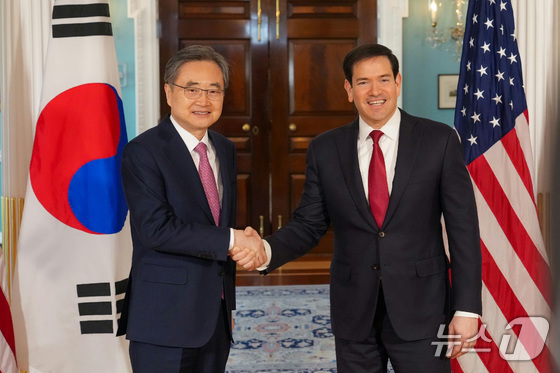
This unproductive diplomatic trip highlights the difficult position government officials are in.
The U.S. has publicly criticized South Korea’s delays in legislative action on investments and has once again threatened tariffs. However, the power to resolve these matters lies not with the administration but with the National Assembly.
Consequently, trade officials find themselves at the negotiating table without any effective leverage, caught between U.S. pressure and domestic political realities. They must persuade, but face structural limitations that prevent them from making concrete commitments.
Critics argue that regardless of the explanations and persuasion attempts made in the U.S., negotiations will remain futile without legislative progress from the National Assembly. This situation only adds to the burden on bureaucrats.
If the tariff hike materializes, it is expected to significantly affect various industries and financial markets, but the government’s response options are limited.
A government official said the United States demands results, while South Korea is left explaining procedures, and added that the situation makes it difficult to satisfy either side.
Ultimately, analysts suggest that the core issue lies not in the willingness to negotiate or diplomatic prowess, but rather in the stagnation of domestic decision-making structures. Bureaucrats are stuck in a role of buying time between the two sides, and even that strategy is reaching its limits.
Another official emphasized that the most effective solution would be to quickly conclude the legislative process in the National Assembly and then use that outcome to persuade President Trump again.