

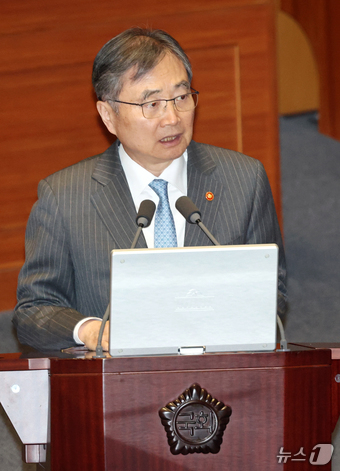
On Monday, Foreign Minister Cho Hyun disclosed that U.S. Trade Representative (USTR) Katherine Tai recently stated that the U.S. would have no choice but to raise tariffs on South Korea if there’s no improvement in Korea’s non-tariff barriers.
Minister Cho explained this during a parliamentary Q&A session on political, diplomatic, unification, and security affairs. He recounted that Tai made these remarks during their meeting last week when he visited the U.S. Cho added that Tai mentioned she couldn’t dedicate too much time to Korea alone as she needs to negotiate with other countries as well.
Cho relayed Tai’s statement that without progress on non-tariff barrier improvements, the U.S. would dispassionately raise tariffs to address the trade deficit. He noted that he strongly disagreed with this approach, leading to an extensive debate.
According to Cho, Tai even presented a chart detailing trade deficit figures with various countries to illustrate her position.
Cho also mentioned that Tai expressed her need to engage in trade negotiations with all countries, hoping that Korea would understand this and that the Korean government would promptly participate in discussions.
On February 3, Minister Cho visited the U.S. and met with Secretary of State Antony Blinken and USTR Tai to discuss solutions to the issue of mutual tariff increases.
Earlier, on February 6, during a press briefing with correspondents in Washington, D.C., Cho noted that Tai understands the potential repercussions of tariff reimposition but emphasized the importance of Korea demonstrating progress not only in strategic investments but also regarding non-tariff barriers. His statements in the National Assembly provided a more detailed account of his conversation with Tai.
The U.S. and South Korea had planned to hold a Korea-U.S. Free Trade Agreement (FTA) Joint Committee meeting in December to discuss non-tariff barrier issues, but they have yet to set a specific date for the meeting.