

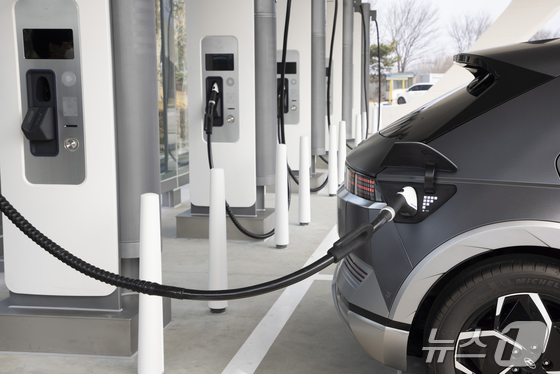
The government is moving to introduce an automatic payment system that completes authentication and billing at once when an electric vehicle is connected to a charger. The change is expected to improve user convenience by eliminating the need for repeated card authentication and app use.
The climate and energy ministry said on the 24th it will hold a public hearing on the introduction of Plug & Charge (PnC) on the 25th at the SMEs DMC Tower in Asia.
PnC is a technology that automatically authenticates the vehicle and processes payment simultaneously when it is connected to a charger. It removes the need for users to verify their identity using a membership card or mobile app, as required under the current system.
At the hearing, the government plans to explain the need for PnC adoption and its expected benefits, and discuss key considerations in designing the system. The Korea Electrotechnology Research Institute will present implementation measures, followed by a panel discussion involving academia, testing institutions, user groups and government officials.
The ministry also plans to establish a unified national authentication system alongside the introduction of PnC and expand the foundation for smart charging. Based on communication between vehicles and chargers, it aims to develop more advanced charging services in the future.
The government aims to introduce PnC on a priority basis this fall, viewing it as a key technology to simplify charging procedures and improve the overall EV user experience.