

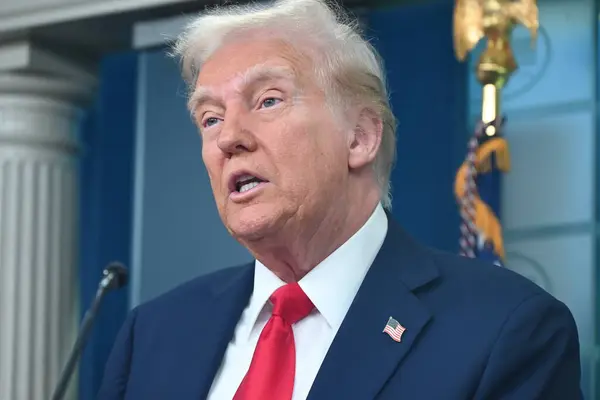
President Donald Trump announced on Tuesday that Japan has officially launched its first investment projects as part of a 550 billion USD commitment to the United States. These projects include investments in oil and gas in Texas, power generation in Ohio, and critical minerals in Georgia.
Trump shared his excitement on Truth Social, stating that he’s thrilled to announce three major projects in strategic sectors: oil and gas in Texas, power generation in Ohio, and critical minerals in Georgia.
He explained that a significant trade agreement with Japan had just taken effect, adding that Japan is now officially moving forward with its first investment projects under their 550 billion USD commitment to invest in America.
Trump emphasized that this is part of their historic trade deal aimed at revitalizing America’s industrial base, promising to create hundreds of thousands of quality jobs and bolster national and economic security to unprecedented levels.
The President stressed the magnitude of these projects, crediting the very special word tariff for making them possible. He highlighted that the Ohio gas power plant would be the largest in history, the Gulf Coast LNG facility would boost energy exports, and the critical minerals facility would end foreign dependence.
Trump concluded by saying that America is building, producing, and winning again, describing it as an exciting and historic moment for both the U.S. and Japan.
This announcement of Japan’s initial U.S. investment projects has also captured significant attention in South Korea, which is preparing to fulfill its own 350 billion USD investment commitment.
South Korea and the U.S. reached an agreement to reduce mutual tariffs imposed under the International Emergency Economic Powers Act (IEEPA) and Section 232 of the Trade Expansion Act on automobiles from 15% to facilitate the 350 billion USD investment.
Based on discussions during two summits last August and October between President Lee Jae-myung and President Trump, they released a joint fact sheet in November outlining this agreement.
However, on January 26, Trump declared he would raise tariffs on South Korea back to 25% due to delays in legislative action on the U.S.-Korea trade agreement.
Despite high-level South Korean officials visiting the U.S. for talks, they received no definitive answer on withdrawing the tariff increase. On February 9, the South Korean National Assembly passed a proposal to form a special committee to discuss the special law on U.S. investments.
The White House, responding to a News1 inquiry, viewed the formation of this special committee as positive progress in South Korea’s efforts to fulfill its commitments under the U.S.-Korea trade agreement.
International media have speculated that Japan would swiftly announce its first investment details to avoid a sudden tariff increase similar to South Korea’s situation. The Nikkei reported on February 10 that Trump was furious over Japan’s failure to meet its investment commitments.
On February 5, Trump publicly endorsed Prime Minister Sanae Takaichi ahead of Japan’s House of Representatives election, stating on Truth Social that he looks forward to welcoming Prime Minister Takaichi to the White House on March 19.
Trump’s scheduling of a meeting with Takaichi while supporting her has been interpreted as pressure to expedite Japan’s investment commitments.