

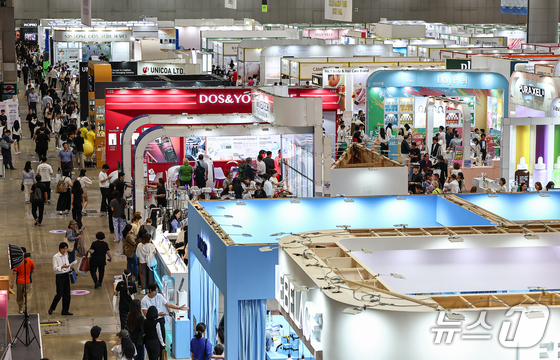
As President Donald Trump reignites the tariff war, the K-beauty and K-fashion industries are closely monitoring the situation. While a U.S. court has put the brakes on country-specific differential tariffs, Trump is pushing for a blanket 15% global tariff on all imports.
Industry experts, however, suggest that this measure is unlikely to significantly impact immediate sales or demand.
Reports from the industry on Tuesday indicate that the current robust demand for K-beauty products in the U.S. market means a 15% tariff is unlikely to cause a sharp decline in sales. The situation is considered manageable, with no need for drastic changes to pricing strategies or logistics.
Companies with local production facilities in the U.S. are even less likely to feel the impact. Kolmar Korea, for instance, maintains a significant portion of its production locally through its U.S. factories, minimizing the tariff burden. A Kolmar spokesperson stated that they’re closely monitoring market changes to ensure stable product supply while minimizing the impact of these tariff measures.
There’s also heightened interest in manufacturers like Cosmax and Amorepacific, which heavily rely on U.S. sales. However, all these companies are approaching the situation cautiously. With the tariff initially set to apply for up to 150 days, companies are expected to adopt a wait-and-see approach rather than immediately raising prices or scaling back operations.
Industry responses are leaning towards a cautious stance, with little likelihood of a complete supply chain overhaul. The K-beauty industry’s main focus appears to be on gradually enhancing its production and distribution structures within the U.S. market, rather than merely reacting to the crisis. The fashion industry, while experiencing varying degrees of impact across companies, is generally maintaining a vigilant but measured response.
Hansae Co., Ltd., a global fashion original design manufacturer (ODM) company, reports that about 80% of its overseas business comes from the U.S. However, having diversified its production bases primarily in Latin America even before the tariffs were proposed, the company doesn’t foresee a need for drastic changes.
An industry insider commented that this measure doesn’t necessitate a complete restructuring of our supply chain. It’ll manage risks while maintaining its existing strategies. They added that a 15% tariff alone isn’t enough to fundamentally shift the industry’s dynamics.
Like the K-beauty sector, K-fashion anticipates minimal short-term demand contraction or drastic performance changes. However, the increased uncertainty in policy direction poses a risk. Consistent tariff policies could lead to clearer investment decisions and supply chain strategies.
Moreover, it’s unlikely that consumers will see significant price increases. For instance, even for a product priced at 1,000 KRW (about 0.69 USD), the additional costs won’t be solely passed on to consumers. Instead, export brands, local importers, distributors, and sales channels will share the burden, resulting in a relatively modest perceived price increase in the market.
The industry had already begun preparing its response back in August of last year when the possibility of U.S. tariffs first emerged. An industry representative stated that immediately after the news broke, it established an internal response system and started exploring local production possibilities in the U.S. They added that it haven’t detected any significant shift in consumer demand for K-beauty products due to the anticipated tariffs.