

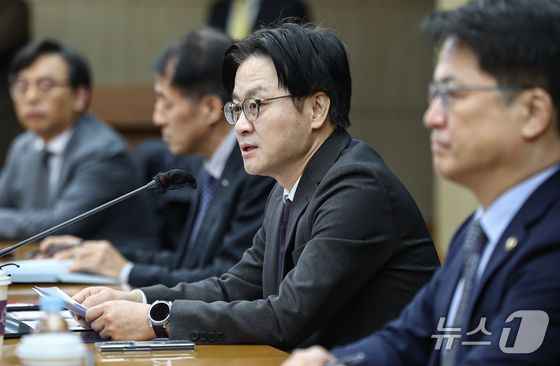
On Monday, South Korea’s Minister of Trade, Industry and Energy, Kim Jeong Kwan, addressed the recent U.S. court ruling on mutual tariffs under the International Emergency Economic Powers Act (IEEPA). He stated that the government will maintain close communication with the U.S. to preserve the benefits secured through the Korea-U.S. tariff agreement and protect export conditions, all while adhering to the principle of maximizing national interests.
Kim made these remarks while chairing a public-private joint strategy meeting at the Korea Chamber of Commerce and Industry, convened to discuss the IEEPA tariff ruling.
The meeting brought together officials from South Korea’s ministries of Trade, Industry and Resources; Economy and Finance; Foreign Affairs; Agriculture, Food and Rural Affairs; Climate, Energy and Environment; Health and Welfare; and SMEs and Startups, as well as the Korea Customs Service. It also included major business groups such as the Korea Chamber of Commerce and Industry, the Korea International Trade Association, the Korea Federation of SMEs, the Federation of Korean Industries, the Korea Trade Investment Promotion Agency, and other industry associations.
Minister Kim emphasized the government’s commitment to bolstering domestic companies’ competitiveness and diversifying export markets in response to potential shifts in export conditions. He also pledged to work closely with relevant agencies and industry associations to provide businesses with timely information on uncertainties regarding tariff refunds.
Despite the IEEPA ruling, Kim expressed concern over the U.S.’s declared intention to impose tariffs on unfair trade practices through Section 301 investigations targeting major countries. He anticipates that U.S. tariff policies will remain aggressive, using various alternative measures such as Sections 122 and 301 of the Trade Act, potentially increasing global trade uncertainty.
Section 301 of the Trade Act grants the U.S. broad retaliatory powers against trading partners’ unfair practices that restrict U.S. trade. This provision was invoked in 2017 against China, leading to ongoing retaliatory tariffs since 2018.
Kim also warned that a uniform 15% global tariff from the U.S. could significantly alter the competitive landscape for Korean companies.
Following the Supreme Court ruling, President Trump initially announced a 10% global tariff under Section 122, quickly escalating it to 15% the next day.
In light of these unpredictable U.S. tariff measures, Kim reaffirmed the government’s commitment to enhancing export competitiveness and diversifying markets.
The Supreme Court’s IEEPA ruling didn’t provide clear guidelines on refunding previously paid mutual tariffs, leaving outcomes dependent on lower court decisions.
Kim concluded by stressing the importance of collaborating with relevant agencies and industry groups to keep businesses informed about uncertainties surrounding tariff refunds. He promised vigilant monitoring of U.S. tariff actions and global trends to develop effective long-term strategies.