

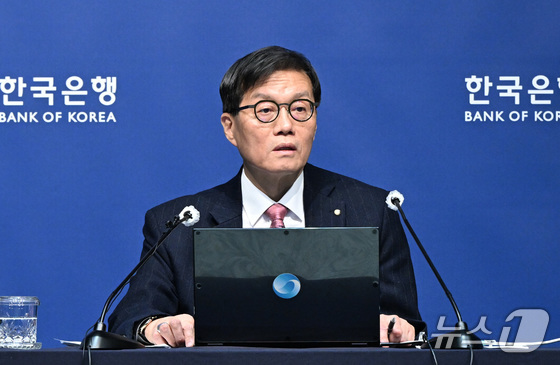
Bank of Korea Governor Lee Chang Yong announced on Thursday that the economic growth forecast for this year has been raised to 2.0%. He explained that the robust semiconductor market and favorable global economic trends are expected to drive exports and facility investment beyond initial estimates, contributing to a 0.35 percentage point increase in this year’s growth rate.
Following the Monetary Policy Committee meeting, he noted that, on the consumption side, improved income conditions, driven by strong corporate performance, contributed an additional 0.05 percentage points.
The Bank of Korea revised its forecast for this year’s real GDP growth rate to 2.0%, up 0.2 percentage points from the previous estimate of 1.8%.
Governor Lee said the IT manufacturing sector, including semiconductors, is expected to contribute 0.7 percentage points to this year’s growth rate, compared to about 0.6 percentage points last year.
He also said the growth contribution is expected to decline slightly next year. This was one factor in lowering the economic growth forecast for next year from 1.9% to 1.8%.
Regarding U.S. tariff policies, he said the impact could vary depending on the U.S. government’s responses, such as item-specific tariffs following the Supreme Court’s ruling on mutual tariff invalidation. However, he added that since Korea maintains the same tariff rates as before, the impact on growth forecasts, including exports, is expected to be limited. He assessed that factors such as the semiconductor market, domestic recovery pace, and major countries’ monetary and fiscal policies pose both upside and downside risks to future growth trajectories.
He explained that the expected delay in construction investment recovery could lower the growth forecast by about 0.2 percentage points.
The Bank of Korea projected next year’s economic growth rate at 1.8%.
The central bank unanimously decided to maintain the benchmark interest rate at 2.50% for the sixth consecutive time.
Explaining the rate freeze, Governor Lee said that with inflation stable near target levels and growth showing better-than-expected improvements, it was appropriate to keep the current benchmark rate while monitoring domestic and external policy conditions.
He emphasized the need for vigilance regarding financial stability, noting high volatility in financial and foreign exchange markets, as well as the metropolitan area housing market. While housing prices have slowed in response to government measures, he stressed the need to continue monitoring price stability trends given previous high expectations for price increases.
Governor Lee highlighted that household loans, including real estate loans, have risen to levels posing risks to financial stability. He remarked that a concentration of funds in real estate is not desirable in the long term.
He also cited the dollar-won exchange rate volatility as a reason for maintaining the benchmark rate.
He noted that while the exchange rate has decreased significantly recently, volatility remains high. He assessed that despite decreased overseas securities investments by the National Pension Service, other residents’ investments continue to grow at a pace similar to last October and November, indicating ongoing foreign exchange market pressures.
On the domestic economy, Governor Lee said that although construction investment remains weak, private consumption has continued to recover due to improved economic sentiment and income conditions. Despite tariff impacts, exports have sustained significant growth, particularly in IT sectors like semiconductors and computers.
He also mentioned that no Monetary Policy Committee members indicated the possibility of raising interest rates within the next three months.
Regarding market interest rates, he expressed concern about excessive spreads, noting that the yield on three-year government bonds rose to 3.2%, with the spread exceeding 0.6 percentage points.
He continued that even the six-month forward guidance announced this time appears to be higher than what committee members expect. He added that the central bank hopes market adjustments based on the six-month forward guidance will help address interest rate policy uncertainty.