Domestic oil refiners are grappling with supply disruptions of heavy crude oil, prompting them to secure light crude as an alternative. However, this shift has led to a decline in refinery utilization rates and a significant drop in refining profits.
Analysis reveals that substituting heavy crude with light crude causes the operational efficiency of upgraded facilities (HOU) to plummet to 30-40%. Moreover, the yield of low-margin products increases, potentially resulting in opportunity losses of up to 500,000 USD per 100,000 barrels refined.
More Light Crude Blending Boosts Low-Value Products… Raises Profitability Concerns
According to industry sources on Thursday, major U.S. refiners are maintaining refining facility utilization rates around 90%. They continue to process heavy crude by purchasing both heavy and light grades from the Middle East via the Red Sea port of Yanbu, utilizing a swap system to exchange stored heavy crude.
Previously, the industry expected to sustain this operating rate until May or June. The government’s decision to import 270 million barrels of Middle Eastern crude by year-end has provided some breathing room.
However, concerns persist that profitability may decline if heavy crude supply doesn’t stabilize and the proportion of light crude increases.
The primary cause of reduced profitability is the decreased operational efficiency of HOU facilities. For 100,000 barrels processed, heavy crude yields 95-100% efficiency, while 100% light crude drops efficiency to 30-40%.
Operating with 100% heavy crude produces an estimated 1,500-1,800 tons of sulfur daily. In contrast, 100% light crude significantly reduces this to about 100-200 tons. This sulfur production decline could disrupt the supply chain for essential materials used in semiconductor manufacturing.
An industry insider explained that the fundamental need for heavy crude in process operations remains unchanged. While each company’s optimal blending ratio is proprietary, there are inherent constraints when operating refining facilities with a higher proportion of light crude.

Risk of Portfolio Erosion… Opportunity Loss in Refining Light Crude
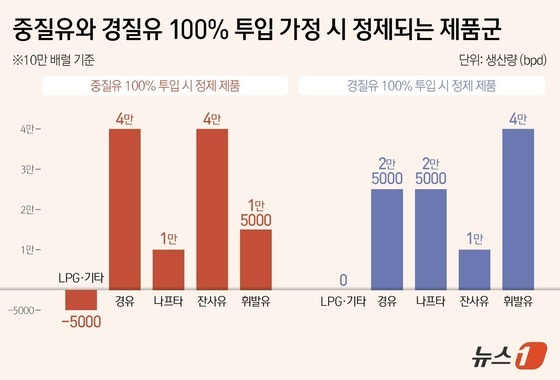
Light crude refining risks damaging product portfolios and incurring opportunity losses. The yield of high-value products drops from 65-70% with heavy crude to 40-50% with light crude. Conversely, the yield of less profitable, low-value products like naphtha surges from around 30% to over 50%.
As of Wednesday, per-barrel product prices were: diesel at 130 USD, gasoline at 125 USD, naphtha at 95 USD, and residual oil at 80 USD. Consequently, value-added estimates for refining 100,000 barrels indicate diminishing profitability with increased light crude processing.
Refining 100,000 barrels of Dubai crude, priced at about 103 USD per barrel, yields approximately 40,000 barrels of diesel, 40,000 barrels of residual oil, 15,000 barrels of gasoline, and 10,000 barrels of naphtha, generating added value of around 11.22 million USD.
After deducting crude oil costs of 10.3 million USD, the hypothetical refining margin is about 920,000 USD.
In contrast, if Brent crude (light) costs rise to 110 USD per barrel, refining it produces about 40,000 barrels of gasoline, 25,000 barrels of naphtha, and 25,000 barrels of diesel, resulting in products valued at around 11.42 million USD.
However, due to higher input costs, the final refining margin is limited to 420,000 USD. This results in an opportunity loss of 500,000 USD per 100,000 barrels compared to heavy crude refining.
An industry expert noted that the strategy of swapping purchased light crude with government-stored heavy crude has its limits. If this situation persists, structural supply chain issues will inevitably arise. Securing stable procurement routes for heavy crude is crucial from a long-term perspective.
Kim Tae-hoon, a senior researcher at the Korea Energy Economics Institute, observed that even the U.S., the world’s largest oil producer, imports heavy crude for its domestic refining operations. If Middle East blockades disrupt heavy crude supply, relying solely on incompatible light crude will make full operations impossible, leading to structural problems.