Market forecasts are increasingly pointing to a delay in U.S. interest rate cuts until after September, as energy supply shocks from the Middle East stoke inflation concerns. The surge in global oil prices has reignited inflation worries, lending credence to expectations that the Federal Reserve will maintain a cautious stance in the near term.
A report from the Bank of Korea’s New York office on Tuesday indicates that major investment banks see a high probability of the Fed resuming rate cuts in September this year.
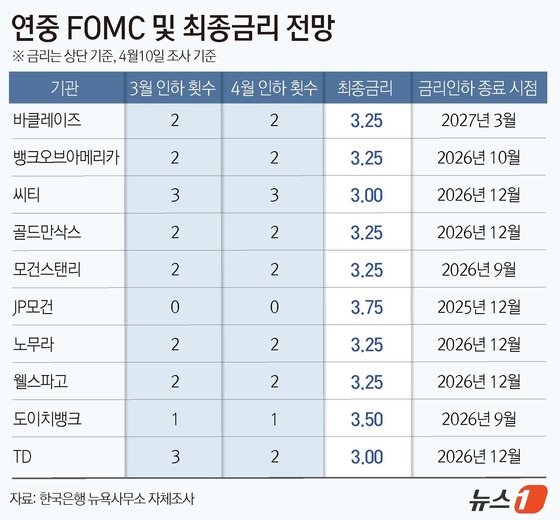
Of the ten institutions surveyed, Morgan Stanley stood alone in predicting two rate cuts before September.
While most investment banks have maintained their forecasts for the number of cuts, they’ve pushed back both the start and end dates for rate reductions. Bank of America (BofA), which initially anticipated two cuts by July, has now postponed its projected end date to October, with a final rate forecast of 3.25%.
Citigroup, Nomura, and Wells Fargo have also delayed their end dates from September to December. Citigroup envisions three cuts leading to a final rate of 3.00%, while Nomura and Wells Fargo expect two cuts resulting in a 3.25% rate. TD Bank foresees two cuts culminating in a 3.00% rate.
In contrast, Morgan Stanley maintains a relatively early end to its cut trajectory, projecting two cuts to reach 3.25% by September, while Deutsche Bank anticipates one cut to 3.50% in the same month. Barclays offers the most extended cut timeline, proposing two cuts to a final rate of 3.25% by March next year.
JPMorgan Chase stands firm on its forecast of no rate cuts this year, maintaining a final rate projection of 3.75% and asserting that the rate cut cycle concluded last December.
Market Interest Rate Expectations Trend Upward; September U.S. Policy Rate Forecast Rises to 3.62%
Market rate expectations are also shifting higher. Futures markets now reflect a projected policy rate for September that has climbed from 3.25% in February to 3.50% in March, and further to 3.62% in April.
This upward trend suggests a gradual retreat from earlier rate cut expectations.
The Bank of Korea reports that investment banks expect the Fed to maintain a cautious stance in the near term, as the effects of the energy supply shock may take time to fully manifest in future price indicators.
Indeed, energy-driven pressures are already evident in price data. With Fed Chair Jerome Powell’s term set to end on May 15, just a month away, inflation concerns stemming from Middle Eastern energy supply disruptions are becoming increasingly tangible.
Last month’s U.S. Consumer Price Index (CPI) rose 3.3% year-over-year, marking the highest increase since May 2024. Notably, gasoline prices surged 18.9%, driving the inflation rate for non-durable goods to 4.9%, up sharply from 1.7% the previous month. Short-term inflation expectations (one year) climbed to 3.8%, a 0.4 percentage point increase from the previous month’s 3.4%.
The Bank of Korea analysis suggests that prolonged military conflicts in the Middle East could fuel inflation expectations and potentially spread price pressures to other sectors.
Regarding last month’s Federal Open Market Committee meeting, the Bank noted that markets interpreted Chair Powell’s assessment of constrained inflation moderation due to oil price shocks, along with fewer-than-expected rate cut opinions, as hawkish.