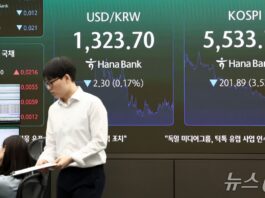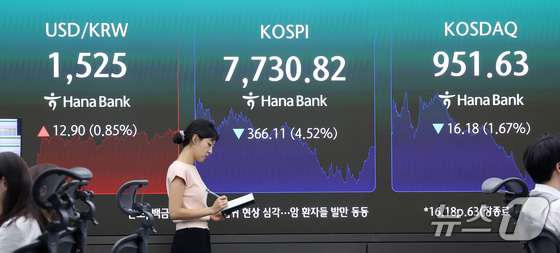
The escalating tensions between the U.S. and Iran are sending shockwaves through the South Korean stock market, with pre-market trading showing a nearly 5% plunge.
As of 8:02 a.m. (Korean time) on Thursday, NextTrade’s pre-market data reveals a 4.71% decline across 519 traded stocks.
Tech giants Samsung Electronics and SK Hynix have been hit hard, with their shares tumbling over 6%. Samsung’s stock price has dropped to 280,000 KRW (approximately 184 USD), while SK Hynix has fallen to 1,920,000 KRW (about 1,258 USD).
The downturn is widespread among blue-chip stocks, with Samsung Electro-Mechanics and Hyundai Motor seeing drops of 8.42% and 6.48% respectively. However, defense-related stocks are bucking the trend, with Hanwha Aerospace, Hyundai Rotem, LIG Defense and Aerospace, and Hanwha Systems all posting gains.
This market turbulence appears to be a direct response to the resurgence of Middle Eastern geopolitical risks, which has already rattled U.S. markets. While the May U.S. Consumer Price Index met expectations, President Donald Trump’s ominous hint at potential strikes on Iranian power plants has stoked market fears. The situation intensified just before the opening bell, with Iran announcing a complete blockade of the Strait of Hormuz in retaliation to U.S. airstrikes.
After hours, Oracle Corporation’s better-than-expected earnings report was overshadowed by its announcement of a 40 billion USD fundraising plan. This news has amplified concerns about the company’s investment strategy, sending its stock plummeting over 9% in after-hours trading.
Market volatility is expected to persist due to several upcoming events. Today marks the first futures and options expiration day following the introduction of single-stock leveraged products. Additionally, the anticipated SpaceX listing could trigger significant global capital movements.
Han Ji-young, an analyst at Kiwoom Securities, offers this insight: Despite the reassuring U.S. May consumers price index (CPI) figures, the domestic market is likely to open lower. This downturn is driven by reports of U.S. airstrikes on Iran, weakness in semiconductor stocks following negative news from SoftBank, and uncertainties surrounding today’s simultaneous expiration of futures and options contracts. However, it’s worth noting that the recent market adjustments appear to be more of a short-term technical correction, stemming from exchange-traded fund (ETF) related supply disruptions and a natural cool-down after the market’s rapid ascent. In light of this, maintaining current positions may be the most pragmatic approach for investors.