


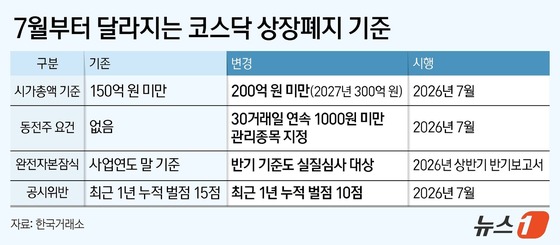
Starting next month, KOSDAQ delisting requirements will significantly tighten. With the implementation of four major criteria – including raising the market capitalization threshold, eliminating penny stocks, and introducing semi-annual reviews for complete capital erosion – some financially vulnerable biotech and pharmaceutical companies are expected to face a survival test.
According to industry sources on Thursday, the Financial Services Commission announced reform measures in February for swiftly and strictly delisting underperforming companies. In May, the Korea Exchange finalized amendments to its listing regulations. The changes center on four key points. First, the KOSDAQ’s market capitalization delisting threshold will increase from 150 billion KRW (about 98.5 million USD) to 200 billion KRW (about 131.4 million USD) starting July 1. This threshold will rise again to 300 billion KRW (about 197.1 million USD) in January next year, accelerating the timeline originally set for 2027 and 2028.
New delisting criteria for penny stocks, priced below 1,000 KRW (about 0.75 USD), will also take effect in July. Stocks remaining under 1,000 KRW for 30 consecutive trading days will be designated as management items. Failure to recover above 1,000 KRW (about 0.75 USD) for 45 out of the following 90 trading days will trigger the delisting process. This change closes a loophole where companies artificially inflated stock prices through consolidation to avoid delisting, as post-consolidation stocks priced below par value will also fall under the penny stock requirements.
The complete capital erosion criteria will also be strengthened. Previously, only year-end complete capital erosion warranted delisting. Now, semi-annual complete capital erosion will be added to the substantive review criteria. This applies to semi-annual reports for the first half of this year, with August submissions being the first under review. The threshold for disclosure violations will lower from 15 cumulative points over the past year to 10 points. In February, Financial Services Commission Chairman Lee Ok-kyung stated that these stricter delisting criteria could lead to the exit of up to 150 companies from KOSDAQ this year.
This regulatory shift puts many KOSDAQ biotech and pharmaceutical companies at risk of management item designation. News1’s analysis of Korea Exchange sector classification data (as of June 10) revealed that 21 out of 230 listed companies in the KOSDAQ pharmaceutical and medical precision equipment sector will fall under the new market capitalization or penny stock criteria next month.
Companies with market caps below 200 billion KRW (about 131.4 million USD) include Alpha AI (105 billion KRW, about 69 million USD), Vistoss (111 billion KRW, about 72.9 million USD), Olipass (134 billion KRW, about 88 million USD), PCL (168 billion KRW, about 110.4 million USD), and Woojin BNG (179 billion KRW, about 117.6 million USD). These firms risk management item designation if they fall below the threshold for 30 consecutive trading days after July 1. Fourteen companies qualify as penny stocks, including Telcon RF Pharmaceutical (360 KRW, about 0.27 USD), Sejong Medical (412 KRW, about 0.31 USD), Utilax (959 KRW, about 0.72 USD), and Enzychem Lifescience (990 KRW, about 0.74 USD). Three companies – Alpha AI, Noble M&B, and Joa Pharmaceutical – meet both criteria. When the cap rises to 300 billion KRW (about 197.1 million USD) in January, 13 more companies valued between 200-300 billion KRW will enter the danger zone.
Industry insiders acknowledge the regulations’ intent but stress the need to consider biotech’s unique characteristics. New drug development often spans years or decades, involving substantial research and development (R&D) costs. Many companies operate at a loss long after going public. There are concerns that tighter listing requirements could impede research-focused biotech ventures by worsening their funding conditions.
An industry source commented that while it supports the policy’s intent, the stricter listing maintenance conditions may overlook biotech firms’ unique nature, potentially stifling innovation. It needs flexible application reflecting industry specifics to avoid driving promising ventures from the market.
Conversely, the securities industry anticipates improved market trust through the exit of underperforming companies. KB Securities analyst Tae Yoon-sun noted that it expects qualitative improvements through increased competition and market-wide valuation reassessments. As this policy is based on structural changes rather than short-term stimuli, it could yield positive long-term effects.