

Samsung Electronics continues to lead the global dynamic random access memory (DRAM) market this year, while Micron is hot on the heels of SK Hynix.
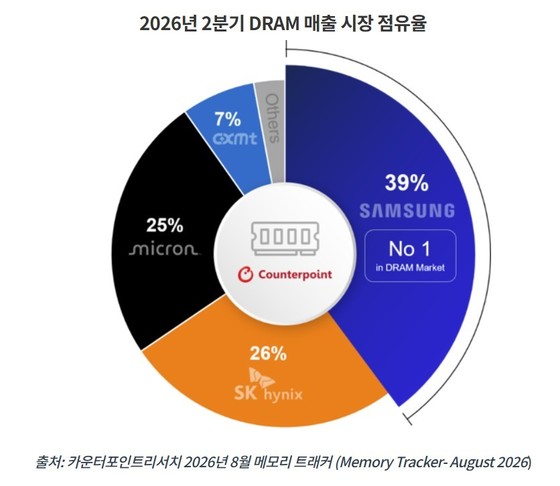
Counterpoint Research’s Global Memory Tracker for Q2 2026 reveals that Samsung maintains its top position with a 39% market share in the DRAM sector. SK Hynix follows with 26%, while Micron holds 25% of the market.
Samsung’s market dominance is attributed to increased demand for general-purpose DRAM, favorable price trends, and an expanded presence in the high-bandwidth memory (HBM) segment.
With prices expected to rise further in Q3, Samsung’s performance is set to strengthen. The tech giant projects its HBM4 sales, which began mass production this year, to triple quarter-over-quarter. By year-end, HBM is forecast to constitute over 60% of Samsung’s total memory revenue.
In a notable shift, SK Hynix saw its market share drop from 39% to 26% year-over-year, despite a 214% revenue surge. Meanwhile, Micron has been steadily gaining ground.
Counterpoint Research attributes SK Hynix’s market share decline to its high exposure to HBM, which experienced price drops. The firm’s early long-term agreements (LTAs), negotiated during rising memory prices, now appear less favorable in the current market.
Q2 saw general-purpose DRAM prices spike compared to Q1, while HBM prices fell year-over-year. Analysts anticipate a sharp rise in HBM prices next year, following the general-purpose DRAM trend.
The research firm suggests that the SK Hynix-Micron rivalry will be determined by production capacity and LTA strategies.
China’s Changxin Memory Technologies (CXMT) captured 7% of the market, posting a staggering 716% year-over-year growth, driven by robust domestic demand and expanded production.
Counterpoint Research speculates that CXMT could significantly alter the market landscape within a year if it can scale up to meet both domestic and international Tier 1 customer demands. The key question, they emphasize, is not how but when CXMT will join the memory industry’s top three.