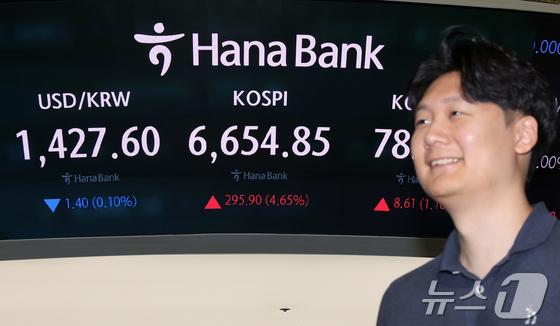
The unprecedented currency cooperation between the U.S. and Japan has created a favorable environment for South Korean foreign exchange authorities to defend KRW’s value. Market expectations are growing for the KRW-to-USD exchange rate to return to the 1,300 KRW (about 1 USD) range.
This move can prevent the JPY’s depreciation from spreading to the KRW due to regional currency synchronization. The U.S. has demonstrated a direct interest in stabilizing Asian currencies, which many view as a strong ally in South Korea’s exchange rate strategy.
For the Bank of Korea, which has grappled with concerns about economic polarization and interest rate management constraints due to the high exchange rate coinciding with semiconductor-driven K-shaped growth, the strengthened cooperation among South Korea, the U.S., and Japan has significantly eased policy management pressures.
Why Intervene in JPY After 15 Years? U.S. Treasury Stability and Trump’s Policies Play a Role
On July 31, the U.S. intervened in the JPY market for the first time in 15 years by selling euros to purchase JPY. Treasury Secretary Scott Bessent explained on August 4 that this action aims to prevent the JPY’s weakness from spreading to other Asian currencies, including the KRW.
The unusual intervention is rooted in the practical interest of stabilizing the U.S. Treasury market. If Japan were to sell over 1 trillion USD in U.S. Treasuries to defend the JPY’s value, it could trigger a decline in Treasury prices and an increase in interest rates.
For the U.S., addressing the JPY’s depreciation is more beneficial to its market stability than allowing it to continue. A senior official from the foreign exchange authorities explained that from the U.S. perspective, cooperating with Japan to intervene might be preferable to causing a market shock.
This aligns with the Donald Trump administration’s reindustrialization strategy. Brad Setcher, a researcher at the Council on Foreign Relations (CFR) and former Treasury and the United States Trade Representative (USTR) official, noted in a recent report that undervalued Asian currencies divert global production and investment away from the U.S. and towards Asia.
This trend directly conflicts with the Trump administration’s goals of attracting domestic manufacturing investment, improving the trade balance, and drawing global funds back to the U.S.
U.S. Response Shifts Gears: Trilateral Cooperation Eases Pressure on Foreign Exchange Authorities
South Korean foreign exchange authorities implemented market stabilization measures around the same time as the U.S.-Japan intervention. Subsequently, Secretary Bessent noted that if the JPY continues to weaken, other currencies may follow suit, specifically mentioning the KRW’s excessive volatility.
While the U.S. actions don’t officially endorse South Korea’s foreign exchange market interventions, they have significantly reduced the pressure felt by authorities when considering market interventions, as the U.S. has identified Asian currency weakness as a problem and mobilized actual funds to address it.
Cooperation among South Korea, the U.S., and Japan has reportedly strengthened recently. A senior official stated that Secretary Bessent’s recent comments carry much more weight than his verbal interventions in January. Another official noted that the level of trilateral cooperation has increased markedly.
Record Export Boom and ADR Effects Fuel Expectations for 1,300 KRW Exchange Rate
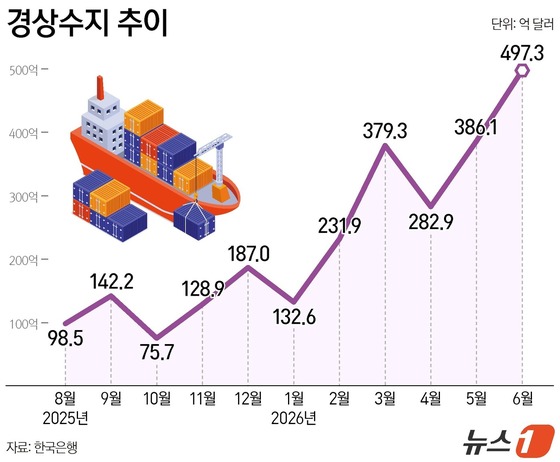
South Korea’s large current account surplus provides its own support for a strong KRW. This foundation for currency appreciation is even more robust than Japan’s.
The issuance of American Depositary Receipts (ADRs) by SK Hynix is also cited as a key factor in the recent decline of the USD-KRW exchange rate. Choi Kyu-ho, a researcher at Hanwha Investment & Securities, estimates that the conversion of 13 to 16.5 billion USD out of a potential $26.5 billion has lowered the exchange rate by about 45 to 57 KRW (about 0.034 to 0.043 USD).
Analysts agree that the combined effects of export companies selling USD, banks proactively selling spot foreign exchange, authorities’ market stabilization measures, and U.S. rate checks have contributed to a significant drop in the exchange rate.
Some within the foreign exchange authorities believe that South Korea’s structural fundamentals generally point toward a stronger KRW. The unprecedented scale of the current account surplus, in particular, is raising expectations for a stable appreciation of the KRW going forward.
Analysts predict that this U.S. intervention will allow the KRW to break away from regional currency synchronization and more accurately reflect underlying fundamentals. One foreign exchange market participant suggested that if current account surplus and export trends continue, the exchange rate could return to the 1,300 KRW (about 1 USD) level by year-end.
Bank of Korea gains monetary policy flexibility as polarization concerns ease
For the Bank of Korea, which has struggled with a prolonged high exchange rate, the strengthened trilateral cooperation is particularly welcome. While South Korea is projected to see growth in the 3% range this year, the recovery is concentrated in the semiconductor and large export companies, raising concerns about economic polarization. Critics argue that despite an unprecedented export boom, the benefits are not spreading evenly across sectors.
The high exchange rate exacerbates these disparities. Bank of Korea Governor Shin Hyun-sung warned during his candidacy that persistent high exchange rates could increase inflationary pressures and burden domestic companies and ordinary citizens, potentially leading to economic polarization. While exporters and large companies benefit from high exchange rates through foreign exchange gains, smaller domestic enterprises and households struggle with rising costs of imported materials and living expenses.
The pressure to rely on interest rates for exchange rate stability is expected to ease. With trilateral cooperation potentially serving as an auxiliary support for exchange rate stability, the Bank of Korea will have more room to focus on domestic conditions such as growth, inflation, and household debt when making future interest rate decisions.
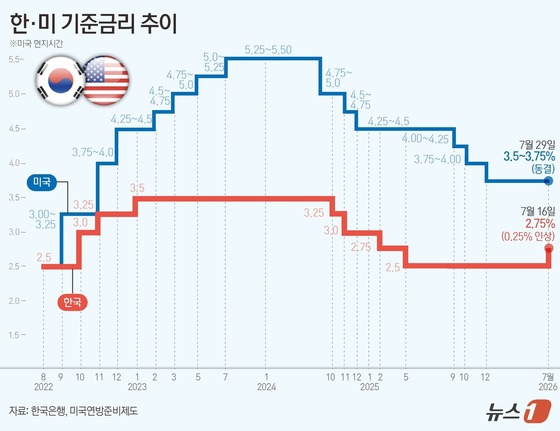
Last month, the Bank of Korea raised the benchmark interest rate to 2.75%, entering a monetary tightening phase for the first time in three and a half years. It’s now crucial to closely monitor the effects of this initial increase on inflation, growth, housing prices, and household debt. As exchange rate constraints on interest rates lessen, the Bank will have more flexibility to adjust the pace of tightening based on domestic economic conditions.
Sustained KRW appreciation remains challenging as markets remain cautious
The market perceives that Asian currency values have temporarily stabilized due to JPY purchases and verbal interventions, maintaining a wait-and-see approach around the low 1,400 KRW (about 1 USD) level. Park Sang-hyun, a researcher at iM Securities, noted that while uncertainties regarding Fed policies and U.S. investments remain, if geopolitical risks ease, the likelihood of the exchange rate entering the 1,300 KRW (about 1 USD) range will significantly increase.
However, it’s premature to assume that policy cooperation alone will sustain the KRW’s appreciation long-term. Without adjustments in Japan’s monetary and fiscal policies or effective measures from South Korean authorities to defend the KRW’s real value, the currency could weaken again if JPY synchronization persists.
As ADR conversions and bank currency hedging conclude, reduced USD supply may highlight import payment needs and overseas investment demands from domestic investors.
Choi from Hanwha Investment & Securities pointed out that past temporary supply-demand factors and policy interventions leading to sharp exchange rate declines typically reversed within 1-3 weeks. He added that while the scale of ADR supply and policy cooperation is unprecedented, the effects are likely temporary. After ADR depletion, external fundamentals and Fed rate outlooks will again drive exchange rates.
Cha Young-hoo from Eugene Investment & Securities assessed that intervention effects will likely be short-lived, given unresolved structural factors behind JPY depreciation. Choi Ye-chan from Sangsangin Securities added that short-term USD-KRW trends may lean downward, possibly testing the 1,300 KRW (about 1 USD) range in Q3, but rapid appreciation like Japan’s is unlikely.
Shin Yoon-jung from SK Securities advised that while short-term KRW strengthening is possible, rapid JPY appreciation could increase KRW volatility due to factors like JPY carry trade unwinding, warranting caution.