On August 6, President Donald Trump unveiled new regulations on polysilicon aimed at reshaping the China-dominated supply chain. By implementing a minimum import price (MIP) and tariff barriers, these measures create a level playing field for non-Chinese polysilicon to compete in the U.S. market.
The impact of this policy is sharply divided. Chinese polysilicon manufacturers, who relied on price as their competitive edge, are likely to lose their foothold in the U.S. market. Conversely, South Korea’s OCI Holdings and Hanwha Solutions’ Qcells division stand to gain from this development.
Notably, the U.S. has promised incentives for companies expanding domestic production facilities. This move suggests an effort to establish price floors for polysilicon, wafers, cells, and modules to counter China’s low-cost strategy while encouraging U.S.-based production.
Trump signed a proclamation under Section 232 of the Trade Expansion Act, applying MIP and tariffs to imported polysilicon and its derivatives. Effective December 4, polysilicon will have a minimum price of 21 USD per kilogram, ingots and wafers 100 USD per kilogram, solar cells 0.22 USD per watt, and modules 0.38 USD per watt. A 15% tariff will also apply to ingots and their derivatives.
MIP Effectively Blocks China’s Low-Cost Offensive
The U.S. move essentially supports non-Chinese polysilicon. By setting a 21 USD per kilogram minimum import price for polysilicon, it neutralizes China’s price advantage. If the declared import price falls below the MIP, tariffs will be imposed on the difference.
Taiwan’s EnergyTrend reports that on August 5, Chinese N-type polysilicon averaged about 4.80 USD per kilogram, while non-Chinese polysilicon averaged 17.50 USD per kilogram. This puts Chinese polysilicon prices at roughly one-quarter of non-Chinese products.
An industry insider explained that the U.S. has artificially raised the price competition baseline to a level where the non-Chinese supply chain can survive, rather than basing it on China’s production costs.
The U.S. dominated polysilicon production in the early 2000s. However, China seized market control through aggressive pricing backed by government subsidies. Currently, China accounts for about 93% of global polysilicon production capacity and approximately 80% of solar manufacturing capacity.
With this measure, the U.S. aims to block low-cost Chinese products from its market and ultimately establish a domestic supply chain. It also plans to offer tariff exemptions for companies investing in U.S. production facilities, potentially boosting the competitiveness of businesses with non-Chinese supply chains.
OCI Holdings and Hanwha Qcells Poised to Benefit as U.S. Expands Production Bases
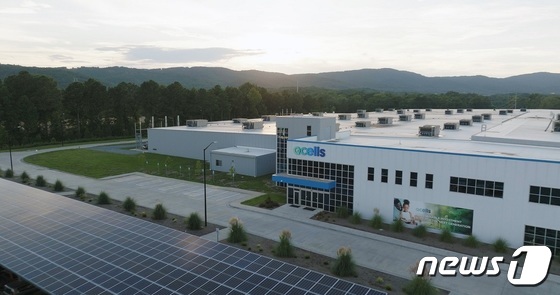
OCI Holdings and Hanwha Qcells are expected to benefit from this policy shift. Hanwha Qcells sells solar products in Georgia, while OCI Holdings operates in Texas.
OCI Holdings produces 35,000 tons of solar-grade polysilicon annually at its Malaysian subsidiary, OCI Terasys, establishing a non-Chinese supply chain. With the U.S. MIP at 21 USD per kilogram and non-Chinese polysilicon averaging 17.50 USD, there’s a 3.50 USD per kilogram difference. This could potentially increase revenue by 122.5 million USD. While existing long-term contracts won’t immediately reach the 21 USD level, OCI’s plans to expand production capacity to 70,000 tons by 2029 make this measure even more significant.
The policy change may also positively impact polysilicon supply negotiations with SpaceX. With Chinese companies effectively excluded, SpaceX now has fewer supplier options.
Hanwha Qcells has established the only complete solar value chain in the U.S., from ingots to modules, centered at its Cartersville, Georgia factory. It sources much of its polysilicon from non-Chinese countries like Germany and Malaysia.
While the polysilicon MIP will increase costs, the solar module MIP is set at 0.38 USD per watt, about 27% above the current 0.30 USD market price. Given Hanwha Qcells’s 8.6 GW module production capacity, even a 0.05 USD price increase could boost annual revenue by over 600 billion KRW (approximately 423 million USD). The U.S.-produced module price increase is expected to outpace raw material cost increases.
OCI Holdings has requested that semiconductor-grade polysilicon be excluded from the investigation, while Hanwha Qcells has asked for duty-free imports of 20,000 tons of solar-grade polysilicon annually from Germany and Malaysia.
IM Investment Securities noted that the U.S. can exclude China without increasing solar power costs by differentiating tariffs on Chinese and non-Chinese polysilicon. This will inevitably strengthen demand for non-Chinese products, and even slight tariffs can be passed on to prices without significant burden.
The industry is closely watching for detailed implementation regulations from the U.S. Department of Commerce. Current plans don’t specify country exceptions, tariff exemption scopes, or incentives for U.S. investments.
While this measure may boost U.S. polysilicon manufacturers’ competitiveness, it could increase costs for solar businesses and semiconductor firms relying on imported wafers and cells. As Chinese polysilicon is pushed out of the U.S. market, it may flood European and Asian markets, intensifying price competition globally.