U.S. Commerce Secretary Howard Lutnik recently made headlines by directly mentioning Korea Zinc while outlining the strategy for rebuilding America’s critical mineral supply chain to President Donald Trump.
Lutnik emphasized that critical minerals are not merely an economic issue but a matter of national security. He outlined plans to establish a supply chain that encompasses mining, processing, refining, and manufacturing within the U.S., highlighting Korea Zinc as a prime example of investment in critical mineral refining.
Industry experts view Project Crucible as a flagship case of U.S.-Korea economic security cooperation, merging Korean refining expertise with America’s resource and industrial foundation. The project, which involves Korea Zinc’s construction of an integrated refining facility in Tennessee, stands as one of the largest private investments in the state’s history.
11 Critical Minerals From a Single Source: The Multi-Metal Approach America Needs
According to Roll Call and other specialized congressional media outlets, President Trump convened a roundtable discussion with over 200 mining industry representatives on August 7 at the State Department in Washington, D.C., to address strengthening the critical mineral supply chain.
During the meeting, Secretary Lutnik stressed that to maintain our edge in advanced manufacturing, AI, semiconductors, energy, and defense, it can’t rely on hostile foreign nations for the industrial raw materials. He underscored the importance of building a comprehensive industrial supply chain within the U.S., from raw materials to finished products.
Lutnik specifically cited Korea Zinc’s 7.4 billion USD critical mineral refining project in the U.S. as a key example of strategic supply chain investment.
America’s primary interest in Korea Zinc stems from its multi-metal capability – the ability to produce and recover various critical minerals through a single integrated process.
At its U.S. integrated refining facility, Korea Zinc plans to produce 11 of the 60 critical minerals designated by the U.S. government. These include zinc, lead, copper, silver, antimony, indium, bismuth, tellurium, palladium, gallium, and germanium, along with semiconductor-grade sulfuric acid.
Minerals such as gallium, germanium, indium, and antimony are strategically vital for semiconductors, defense, telecommunications, and energy sectors. The ability to secure multiple critical minerals at a single integrated facility significantly enhances U.S. supply chain efficiency.
This project expands U.S.-Korea industrial cooperation, traditionally centered on advanced manufacturing in semiconductors, batteries, and automobiles, to encompass the crucial upstream elements of critical minerals and refining.
Synergy of U.S. Resources and Korean Refining Expertise Boosts Feasibility and Implementation Speed
Korea Zinc’s additional competitive edge lies in its advanced refining and processing technology, coupled with an eco-friendly business model – both crucial for U.S. needs.
While rich in mineral resources, the U.S. has faced criticism for its relatively underdeveloped domestic refining and processing capabilities. Even with ample ore supplies, establishing a complete supply chain is challenging without the capacity to convert raw materials into high-purity metals and materials essential for semiconductors, batteries, and defense applications.
Over decades at its Onsan refining facility in Ulsan, Korea Zinc has honed integrated processing technologies, producing zinc, lead, and copper while efficiently handling complex low-grade raw materials and recovering rare and precious metals from refining byproducts.
The company’s strength lies not just in producing single metal types, but in recovering multiple metals from diverse raw materials and recycling refining byproducts and scrap. This approach not only showcases advanced technical prowess but also aligns with a resource-circular, eco-friendly business model by maximizing resource utilization and waste reduction.
Project Crucible is gaining recognition as more than just a Korean company’s U.S. expansion; it represents a complementary supply chain collaboration, combining U.S. resources and industrial policies with Korean refining expertise.
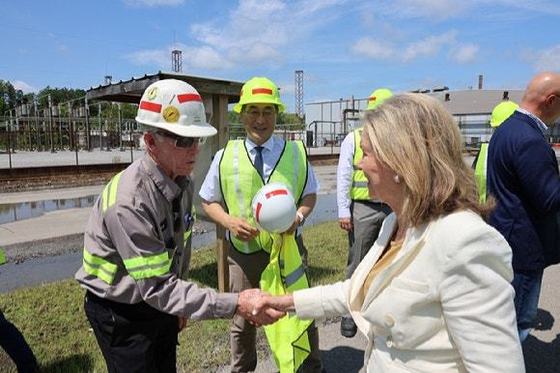
Korea Zinc has launched ‘Crucible Zinc’ by acquiring existing zinc refining facilities and related mines in the U.S. This strategy allows for the utilization of existing industrial infrastructure, bypassing the typically lengthy process of site selection, permitting, raw material network establishment, and skilled labor recruitment associated with new refining facilities.
The U.S. government’s active involvement further underscores Project Crucible’s strategic significance.
Following the federal government’s major investment in the project, Project Crucible became the first Korean-led initiative to be designated under the FAST-41 program, which expedites permitting for large U.S. infrastructure projects.
An industry insider remarked that while the U.S. is rich in mineral resources, it lacks the refining and processing capabilities to produce materials for cutting-edge industries. Collaboration with allied nations possessing proven technologies is therefore crucial. Project Crucible, by combining Korean refining expertise with U.S. resources, market potential, and policy support, transcends mere local production investment to become a pivotal U.S.-Korea economic security partnership.