As the Federal Reserve (Fed) signals a likely interest rate hike, the focus in U.S. financial markets is shifting from whether an increase will occur to how many additional hikes may follow.
Market analysts believe that since this increase has been largely priced in, the trajectory of U.S. Treasury yields after the Federal Open Market Committee (FOMC) meeting will be a key driver for stock market direction. If concerns about further tightening ease, growth stocks, which are sensitive to interest rates, could regain favor. However, if high rates persist, investors may need to be selective, focusing on stocks showing immediate profit improvement.
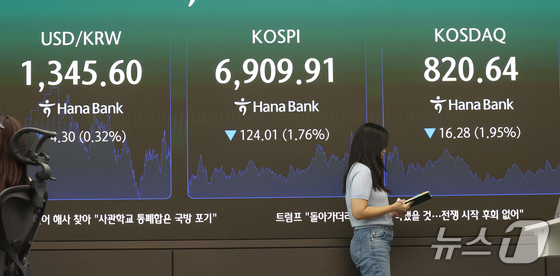
The Korea Exchange reported on Monday that the KOSPI closed at 6,909.91, down 124.01 points (1.76%) from the previous trading day on September 11. After breaking the 7,000 mark on September 9, it retreated to the 6,900 range due to rising global oil prices and U.S. Treasury yields.
As the FOMC meeting approaches on September 15-16, expectations for a rate hike have strengthened. The U.S. core Consumer Price Index (CPI) for August rose 0.3% month-over-month, exceeding the expected 0.2%. The CME FedWatch tool now shows an 87.3% probability of a September rate hike.
Wall Street is now focused on the Fed’s policy guidance post-hike and the reaction in Treasury yields. Lee Jae-man, an analyst at Hana Securities, noted that interest rate futures are pricing in about four hikes by the end of next year. He suggested that a September hike might be seen as partially priced in, potentially easing some pressure.
If the Fed raises rates but signals a slower pace of future hikes, market rates could peak in the short term and then decline. Samsung Securities also noted in a report that if rate hikes help temper inflation expectations, equity markets might view this as a reduction in uncertainty.
Some analysts predict limited additional hikes. Park Sung-woo, a DB Securities analyst, attributed the higher-than-expected core inflation largely to a one-time surge in wireless service prices. Given the limited wage pressures in the labor market, he anticipates only 1-2 minor rate adjustments.
As tightening concerns ease and market rates fall, the discount rate used to value future earnings could also decrease. Hana Securities believes this scenario could benefit sectors like semiconductors, electric vehicle batteries, shipbuilding, pharmaceuticals, biotech, and transportation, which have faced pressure from rising rates despite steady profit growth projections through next year.
Samsung Securities also highlighted the expansion of artificial intelligence (AI) infrastructure and robust corporate earnings as pillars supporting the U.S. stock market. Stock buybacks and earnings from tech giants are seen as providing a floor for the market, suggesting a focus on sectors with strong profit growth potential remains effective.
However, if concerns about additional hikes persist, keeping market rates elevated, investment criteria may need to shift. Hana Securities noted that even if rates hold steady now, the potential for future hikes and the U.S. focus on investment-led growth could limit downward pressure on market rates. This suggests that the market’s interpretation of future tightening expectations is more critical than the immediate rate decision.
In a scenario of sustained high rates, investors should focus on near-term profitability prospects. U.S. companies also need to factor in the impact of recent dollar weakness on profit margins. Analysts specifically pointed to tech hardware and semiconductors as areas of interest, along with sectors like power equipment, defense, and utilities, which have historically performed well during periods of dollar weakness.
Some experts advocate for a defensive approach in the short term. Hwang San-hae, an analyst at LS Securities, cautioned that even the growth potential of semiconductors could be vulnerable to liquidity tightening and cost pressures. Given the recent sharp gains in AI-related stocks, he suggested focusing on financial and energy sectors, while also noting the potential for a rebound in defense stocks due to geopolitical risks. He advised confirming the market’s direction and momentum before increasing positions, rather than rushing in.